
Suikoden was in a strange place during the PS2 era. It was clearly waning in popularity in this time. The third installment experimented with the franchise in ways that polarized many fans. The immediate follow up played things safer, but had a slew of problems all its own. Suikoden V in many ways feels like an apology. It returned to the foundation of what made the first two games so special. I went in with tempered expectations, but was absolutely blown away. This was beyond the shadow of a doubt one of the best PS2 RPGs. It has been years since I last played it, and I recently got the urge to revisit the game. So how does Suikoden V hold up two decades later? Pretty well, actually. Let’s check it out.
Many complaints fans had about Suikoden IV were that it was a prequel. The game was set hundreds of years before the original. For a franchise so firmly entrenched in continuation this made the scenario less interesting. There were less references to the other games, and very few returning characters. Unfortunately Suikoden V is also a prequel. On the plus side it takes place only six years before the original. This means it’s full of references, and shares many of the same cast members. Putting it so close in the timeline was a fantastic idea even if it fails to move the overarching plot forward in any meaningful way. Still, the amount of references and shared cast members helps bring back some of the magic that was lost in its predecessor.
As I’ve already mentioned Suikoden V takes place in the same world as the other games in the franchise. It takes place in a quasi-medieval world heavily based on magic. This time the setting is across the ocean. The Queendom of Falena to be exact. It’s a rich country ruled not by a king, but instead the crowned queen. The country’s main source of power comes from the Sun Rune. This is one of the 27 true runes in the world of Suikoden, and among them is considered to be one of the mightiest. Part V places you in the role of the prince of Falena. He is not a successor to the throne, and therefore his role in the country is mostly grounded in ceremony. It is his younger sister Lymsleia that will one day rule Falena. She’s a child so that’s a long ways off at this point.
The story kicks off as Falena’s sacred games are about to begin. This is the tournament to determine Lymsleia’s future husband and by association the future king of Falena. Unfortunately bad things are cooking for the royal family. Two major factions within the country are conspiring to come in to power. To make things worse the queen is slowly losing her mind under the power of the sun rune. Following the conclusion of the sacred games the winner, the house of Godwin, successfully plots to assassinate both the queen and king to assume total power over the kingdom. The prince and his merry band of friends manage to escape before meeting a similar fate. It’s now up to our royal protagonist to gather allies and fight back in an epic uprising to save not only his sister but the country of Falena itself.
It’s a pretty compelling narrative. I love the change in hierarchy that the setting affords the scenario. Additionally the fact that a powerless prince is the protagonist is pretty interesting. If there’s one complaint I have about Suikoden V’s story it’s that it takes too long to get going. The events I’ve described take place over around ten hours, and it’s just the prologue. The real game starts after that all. That’s where Suikoden V is going to lose a lot of players. The writers spend a lot of time introducing characters and providing backstory. It can be a little long winded in the beginning. Thankfully the payoff is absolutely fantastic. Suikoden V is a slow burner, but almost every plot point and character introduced in the beginning has a big pay off. The developers wanted to tell an exceptionally epic story, and they managed to do just that.
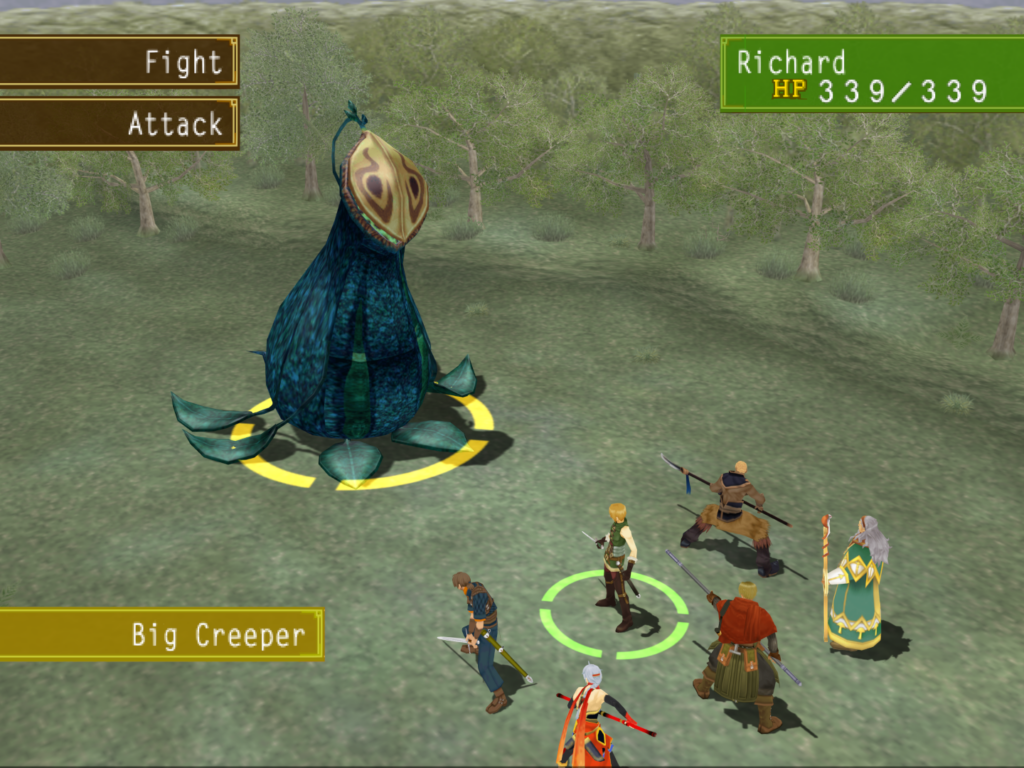
Gameplay is very typical for this franchise. It’s classic Suikoden through and through. The developers even bring back the overhead perspective despite the game being fully 3D. You explore towns, dungeons, and a world map that contains all of them within it. The battle system is very traditional turn based fare. You input commands for your party members and then watch these actions play out while the enemy performs actions against your characters. What’s particularly great is the fact that you can have up to six characters in your party at once like in the early games. Even better is the fact that the pairing gimmick from III has been abandoned. I wasn’t kidding when I said that Suikoden V returns the series to its roots. The gameplay feels almost the same as it did in the first two titles. I mean that in the best way possible.
You have a surprising number of options for combat. You have the standard RPG commands; attack, item, defend, magic (rune), etc. Characters do not equip new weapons to get stronger. Instead you go to various blacksmiths in the world and sharpen these. It’s a mainstay mechanic in the series and I’m glad to see it return. As for the other combat options some characters have combine attacks. These allow two or more to attack in tandem for a more powerful effect. The thing is you need to have the compatible characters both in your party at the same time, and neither can be disabled. It’s like in Chrono Trigger, but it’s not nearly as a common of a feature here. This is why it can be fun to experiment with who you’re using.
The last major command is runes. Some characters come with these built in and they cannot be removed. Other times you have to purchase runes and equip them on one of three slots for the character to gain access to magic. Magic points are handled a little differently here. Basically you have tiers of spells, and each has their own limited number of uses. As you gain more of the magic stat this slowly increases which lets you use this magic more and more in between resting at the Inn. Other runes have non-spell qualities and offer combat bonuses. For the most part you’re going to get new runes by purchasing them at the shops, but some aren’t for sale, and can only be found in chests or as a reward in battle.
There are some pretty big gameplay upgrades here. Your characters still gain experience points and levels to become stronger, and the amount they earn is still on a curve. That means that lower level party members will get more exp per battle than stronger ones. What’s new is the formations. You can find these hidden in treasure chests in the world of Falena. These change where your characters stand in battle in relation to each other. This feature is made significant by the fact that your party members gain boosts to their statistics. These vary depending on the which formation you’re using. The skill system from Suikoden III returns, but it has been revamped and significantly improved. Basically you spend SP earned from battle to upgrade specific stats or abilities of your characters. Like formations you’ll find epic skills in treasure chests that upgrade multiple statistics at a time.
A key mechanic in just about every Suikoden game is the 108 stars of destiny. The same is true for part V. These are the characters that join you on your adventure. Most of them can be used in battle, but others serve very specific purposes. Sometimes they can be only come along in your entourage, and provide you bonuses such as healing your party every turn in battle, increase the likelihood of finding rare items, make it easier to escape encounters, etc. Others exclusively participate in army battles, and some have functions like opening shops or offering services in your headquarters. Even though not all can be used in battle the cast is absolutely massive. You have a ton of options to choose from, and each has their own strengths and weaknesses.
The cast here is more interesting than in most other Suikoden games. Let’s start with the returning characters. The most obvious is Georg Prime. In Suikoden II he was an insignificant guy you met on the side of the road. Here he’s one of the major stars. Getting such backstory on him adds a ton of lore to the franchise. Others like Lorelai and Killey were also insignificant in the past releases, but have a lot of story exposure here. You also have series mainstays like Jeane and Viki that don’t play huge roles in the story, but it’s nice to see them again. The new faces are super interesting as well. This game has the best cast in the franchise in my opinion. Not everyone is significant to the narrative, nor do they automatically join. You have to seek them out and many have rather strange requirements.
One of my favorite parts in any RPG is to pick a party, and stick with it throughout the adventure. Unfortunately Suikoden V doesn’t really allow for that. While you can choose your party you’re often forced into using specific characters for their plot relevance. You aren’t ever really switch out the Prince. Most of the adventure will also require you to bring his bodyguard Lyon as well. Some areas require you to use multiple parties. This includes major battles where each will face off against a different boss, and also the final dungeon itself requires you to use three different parties to proceed. This means you’ll have to go out of your comfort zone to grind levels, sharpen weapons, and purchase equipment for characters you wouldn’t normally use. It’s forgivable because the cast is interesting, but there’s nothing as memorable here as the Luca Blight battle in Suikoden II.
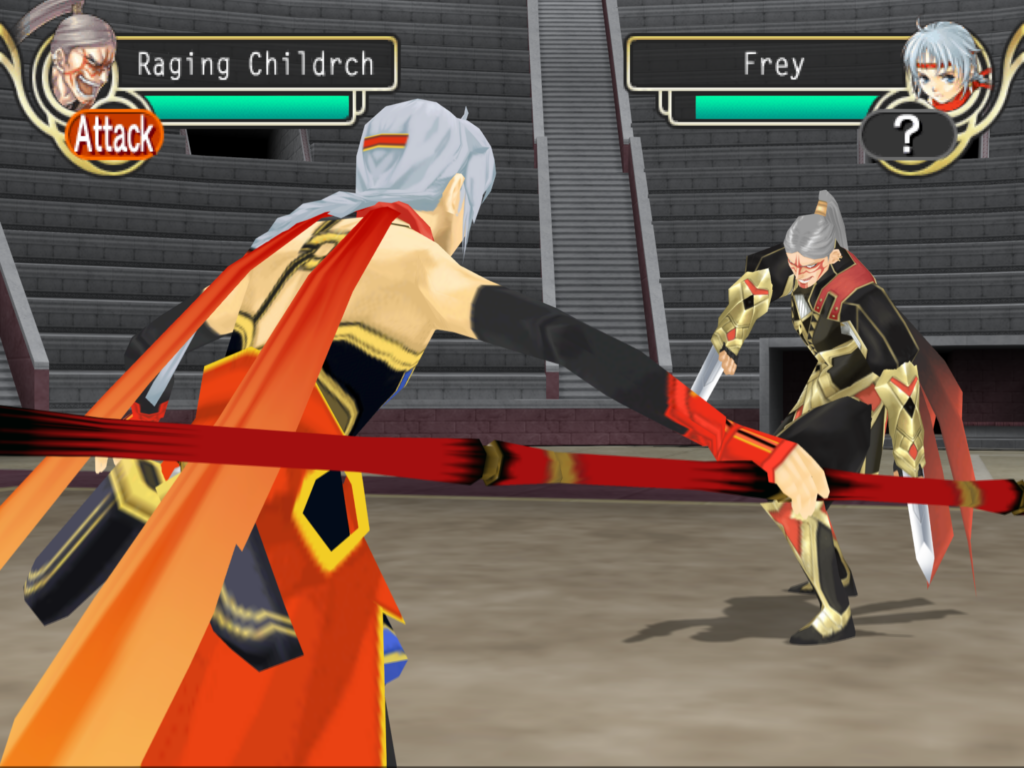
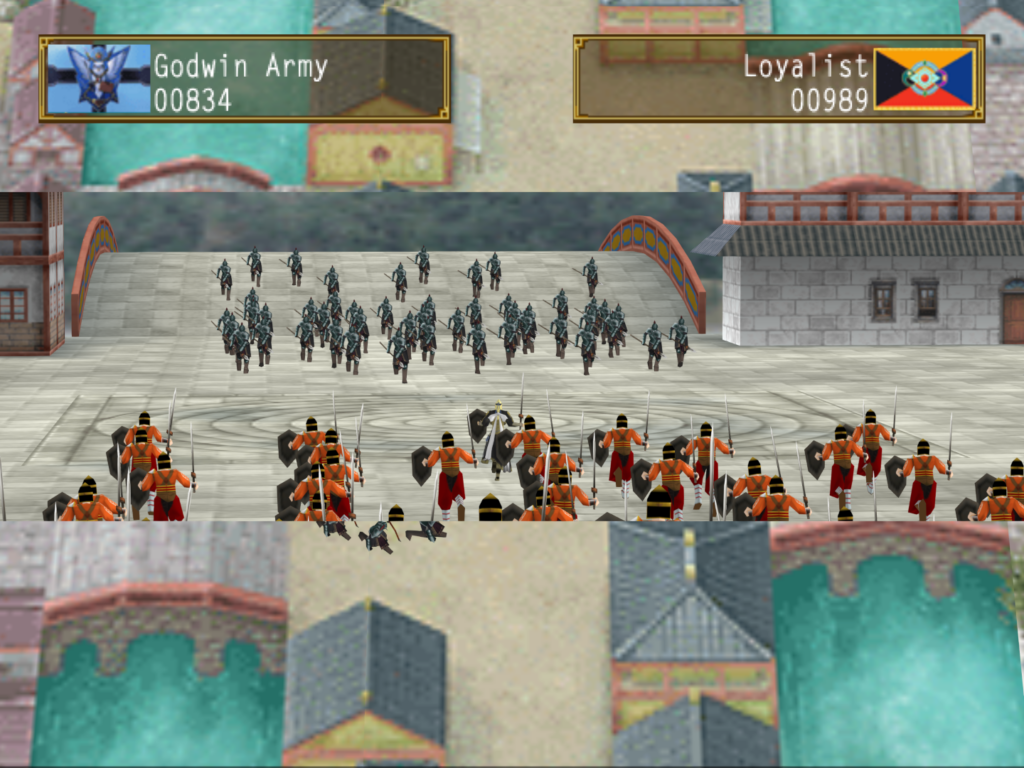
A trademark element in the series has always been the multiple types of battle. Most of the time you’ll be in the standard six party member battles against groups of foes. These are fun, but a little repetitive toward the end. At specific points in the story you’ll engage in duels. These are one-on-one fights wherein you have three commands. Mechanically it’s like rock paper scissors. These are entertaining but serve mostly as cinematic showpieces. Functionally they’re the same as in any other Suikoden title. What’s different here are the army battles. For the first time in the series these play out in real time. You begin by selecting characters for various units. Once the battle begins you select these units and choose their destination. Movement is in real-time, but when they encounter an enemy you lose control and watch the opposing armies fight.
These war battles are an absolute blast. You have very basic unit types such as spears, cavalry, archers, mages, etc. There are a few specialty ones like catapaults too. Each unit type is weak against another. What really adds variety to these events is the abilities. The basic one is charge and allows you to attack without taking damage. Archers have barrage that lets them hit enemies long range. Mages have spells that they can use to decimate foes while avoiding taking damage. Some even target more than one unit at a time. Generally your goal in these war battles is to reach a destination, defeat a specific unit, etc. If a unit is defeated the characters assigned to it can permanently die, and be gone for the rest of the story. The stakes are high, and these are not always easy.
What’s really interesting is the fact that you’re not just limited to land based units. Suikoden V makes an obvious nod to IV by throwing ships into the mix. Ships move just like ground units but are stuck in the water. Some special characters are dual purposed however. These guys can go on both land and water. What’s interesting is the ships have different unit types. Like on land these vessels are weak against specific types and strong against others. What’s really interesting is that some of the war battles take place on both land and sea. In these situations you’ll have to manage the skirmish in two different places. This can make the war battles more difficult because your units are often so spread out. Because of the real-time nature I preferred having either ship battles or land battles, and not both combined.
Unfortunately Suikoden V does have a few minor issues. For one thing the environments are too large. Normally I love exploring huge areas, but even the towns are too large for their own good. Treasure chests are often obscured both here and in dungeons which requires you to pick through every setting with a fine toothed comb. It can get a little old especially when the enemy encounter rate is so high. Even the headquarters (the place where your recruited characters live) is oversized. Worse yet it’s really confusing in design. Even by the end of the game I couldn’t remember where important places like the infirmary were and it was a measure in frustration trying to find them. I love that the headquarters is a castle with multiple towers, but I wish the developers kept all of the important stuff in one place and not off the beaten path.
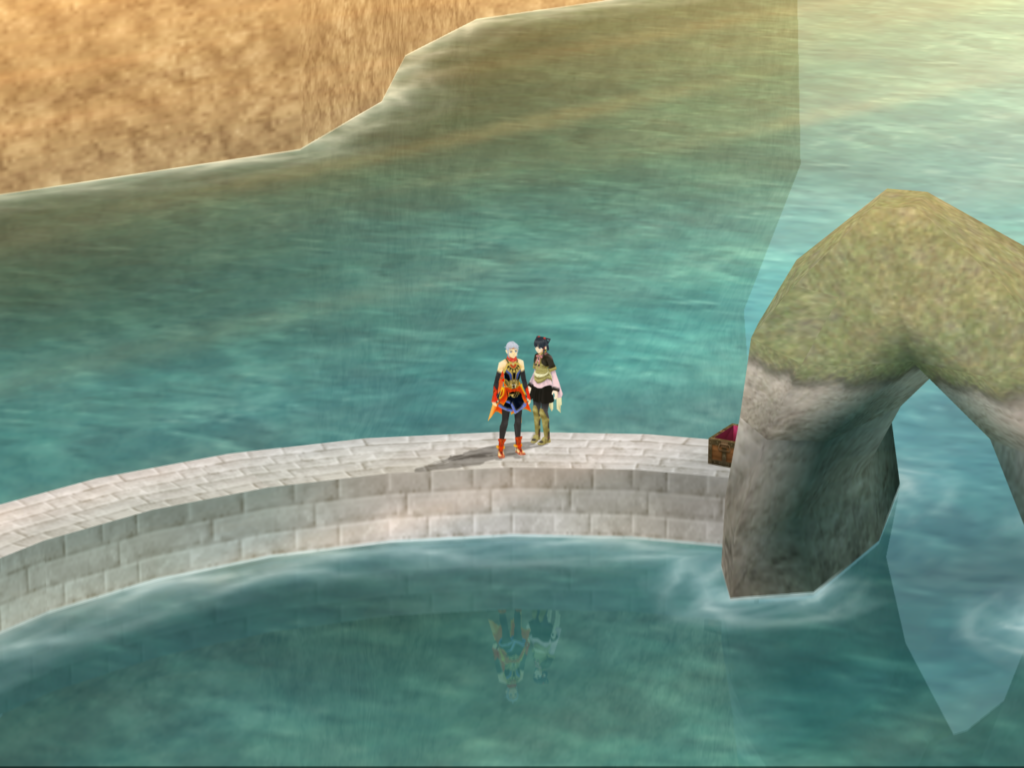
It should also be mentioned that this is the longest Suikoden game to date. This was once a series that touted a 20-30 hour playtime. In Suikoden V you’re looking at a minimum of fifty hours. This isn’t necessarily a bad thing because backtracking isn’t as horrible as it was in the third game, nor is travel as annoying as in the fourth. The world is fun to explore, but again, the environments are too large for their own good. There is also a larger number of towns than previously, and the world map is absolutely gigantic. In my opinion these are good things, but those looking for a quick conclusion to a story aren’t going to get that here. What’s nice is the fact that, while not incredibly difficult, Suikoden V manages to push back against players. I found the challenge level to be absolutely perfect.
I also love the changes made to the visual style in this game. Suikoden III went with chibi designs which looked like wind up toys and was awful, while Suikoden IV tried to go the realistic route and the characters just looked creepy. Suikoden V corrects the ship by going with character models that have realistic proportions, but maintain a soft anime style to them. Animations are seriously on point with motion capture used during cinematic sequences as well as duels. It looks amazing in motion. The environments unfortunately tend to be a bit bland. There aren’t enough textures used in this game. That means some areas look too similar to one another. The soundtrack however is one of the best in the series. Music retains the Asian instrumentation we know and love from previous Suikoden games, but it’s kicked up several notches here. It sounds absolutely amazing.
