
I’ve never been a fan of Final Fantasy X. I’m sure some readers are checked out after that statement but bear with me. This was the first in the series to be released on PS2. It had a massive amount of hype driving it. While critics and fans alike fell in love with the game I was more of a series purist at the time. Several classic conventions were dropped during the development of this title. They were replaced with sub-optimal mechanics. Or at least that’s how I felt back then. Only recently, and after much worse sequels have released, did I decide to give it another go. What I found is that I was wrong with my initial assessment. Final Fantasy X may not be the best game in the series, nor is it even the best PS2 RPG, but it’s still pretty good. Let’s check it out.
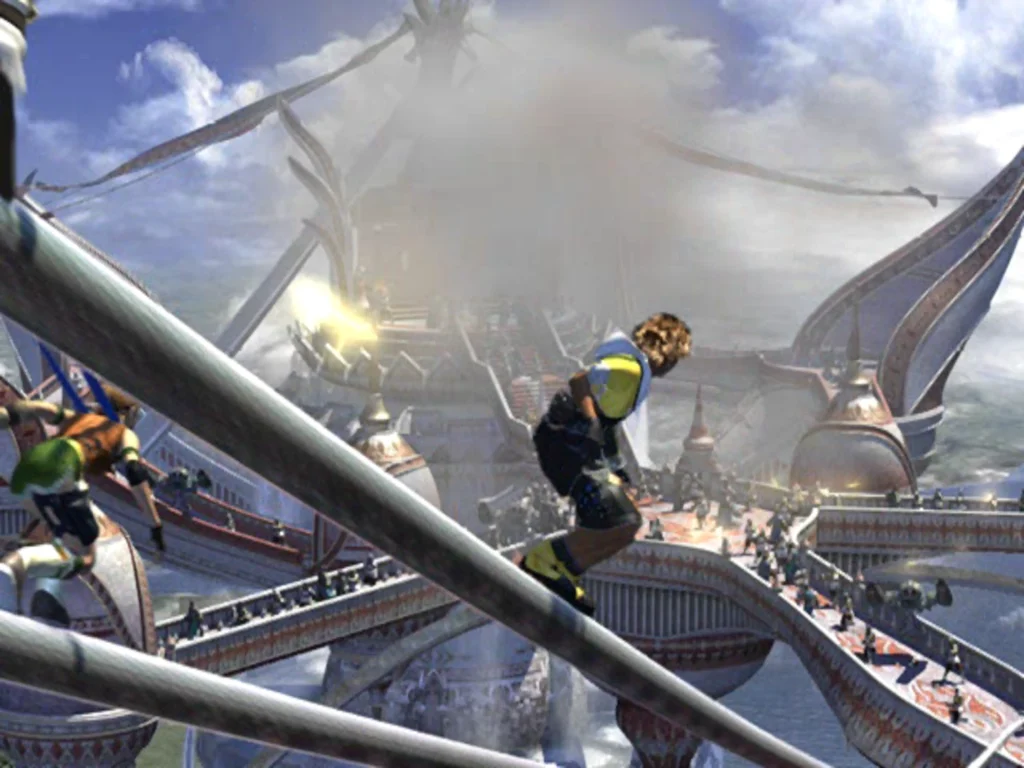
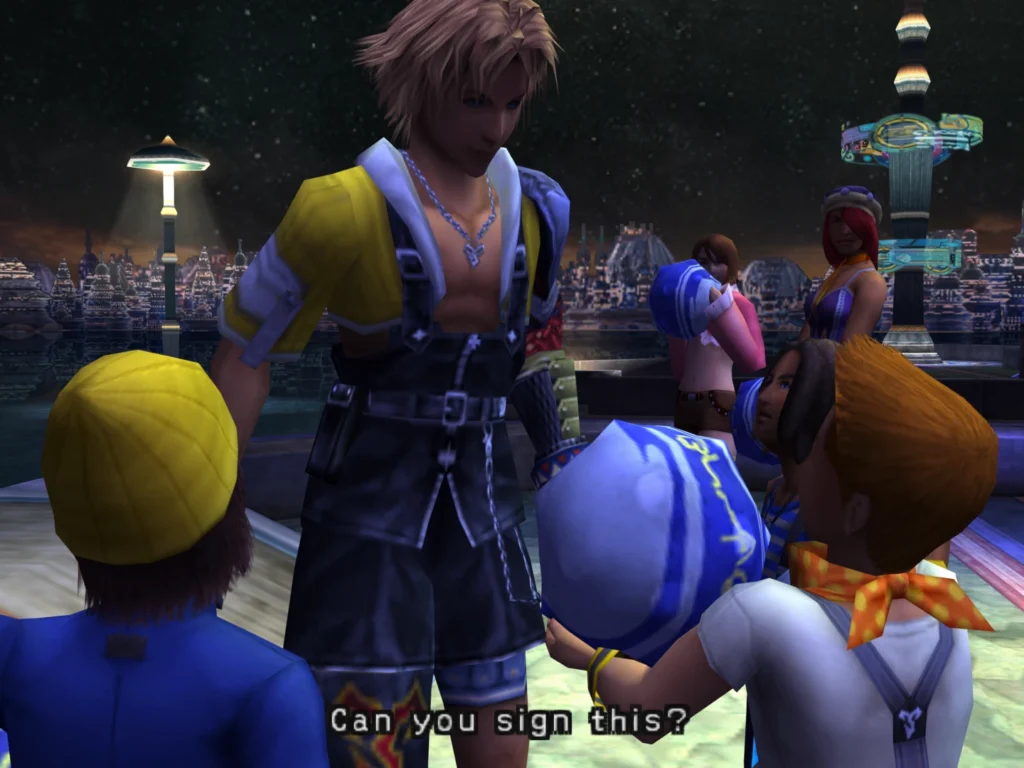
Meet Tidus. He’s a rather unconventional RPG protagonist. The only thing that’s special about him is that he’s the star player of the blitzball team the Zanarkand Abes. What’s blitzball, you may ask? It’s basically underwater soccer in floating orbs of water. Our guy is living a pretty comfortable life as a celebrity in this fictional world that mixes both high fantasy and futuristic technology. The game begins as he’s preparing for a major game of blitzball. During the match things go astray with a giant monster attacking the city. During the chaos Tidus encounters a friend of his father named Auron, and the two are whisked away to an alternate version of the world he knows. It is here that he realizes this new version of Spira exists one thousand years in the future from the time the massive creature, known as Sin, destroyed his hometown of Zanarkand.
Our unlikely hero soon learns that magical summoners (with the ability to manifest giant monsters to do battle for them) are locked in a never-ending cycle against Sin. You see, every ten years a summoner goes on a pilgrimage to defeat the monster. If they are successful, and up to this point they always have been, Sin goes dormant for ten years in an event referred to as ‘the calm.’ With little direction left as to how to return home, Tidus joins up with a group of guardians (the bodyguards of a summoner) to help a young and inexperienced Yuna complete her pilgrimage. Of course, in the world of Final Fantasy nothing is ever so simple. I rather like the fact that the plot starts off with a quest to basically save the world. Usually Final Fantasy beats around the bush with the ultimate goal for the first several hours.
Let me start by saying that I’ve always been a fan of the story in Final Fantasy X. The indie futuristic style, paired with the unusual athlete protagonist is a compelling and interesting combination. Furthermore Final Fantasy X is the first game in the series to feature heavy narration. We constantly hear Tidus’ inner monologue and this helps players to relate. He’s also goofy, and clearly out of his element. The rest of the cast is, for the most part, really interesting too. Wakka takes on kind of a ‘big brother’ role to Tidus. He’s highly likable. Rikku is bouncy and fun which is a stark contrast to many of your other party members. The others, such as Lulu, Kimahri, and Auron are dark and brooding which is what the series at this point was known for. They’re a little boring to be honest. Yuna is awkward, but serviceable.
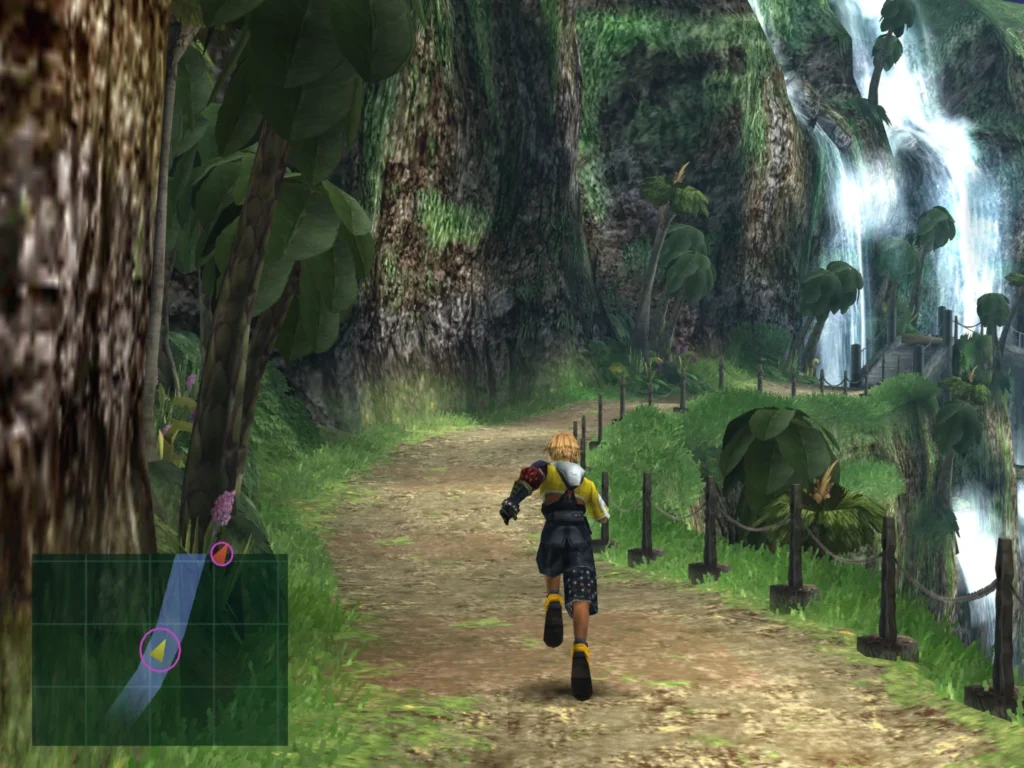
Okay so the story is good, but how does it play? Final Fantasy X was the first fully 3D title in the series. No pre-rendered backgrounds to be found here. The camera moves from a static perspective to follow the player as you explore the polygonal environments. You’re given a mini-map on-screen to help guide you through these areas. Unfortunately one of the game’s biggest problems rears its head immediately. Final Fantasy X is very linear. Exploring the world of Spira often feels like you’re just wandering hallways. There are some open areas, but for the most part the paths are narrow with few branching options. This was a major step backwards for the series because exploration is no longer the joy that it once was. You still have town areas and dungeons, but everything in between is far too straightforward.
Final Fantasy X also lacks a world map. For most of the adventure you’re simply moving from point A to point B with no backtracking available. Later on you get access to an airship and can return to past areas, but you select locations from a menu. This is hardly a good solution in my opinion. The developers tried to alleviate the linearity by including bonus dungeons and side content, but even this is handled oddly. You have to enter coordinates from the map to discover new places. The thing is obtaining these is obtuse. Sometimes the solutions are extremely obscure. It’s nice that they included side-quests, but at the same time, this isn’t very user friendly. In no way shape or form does this make up for the lack of a traversable world map.
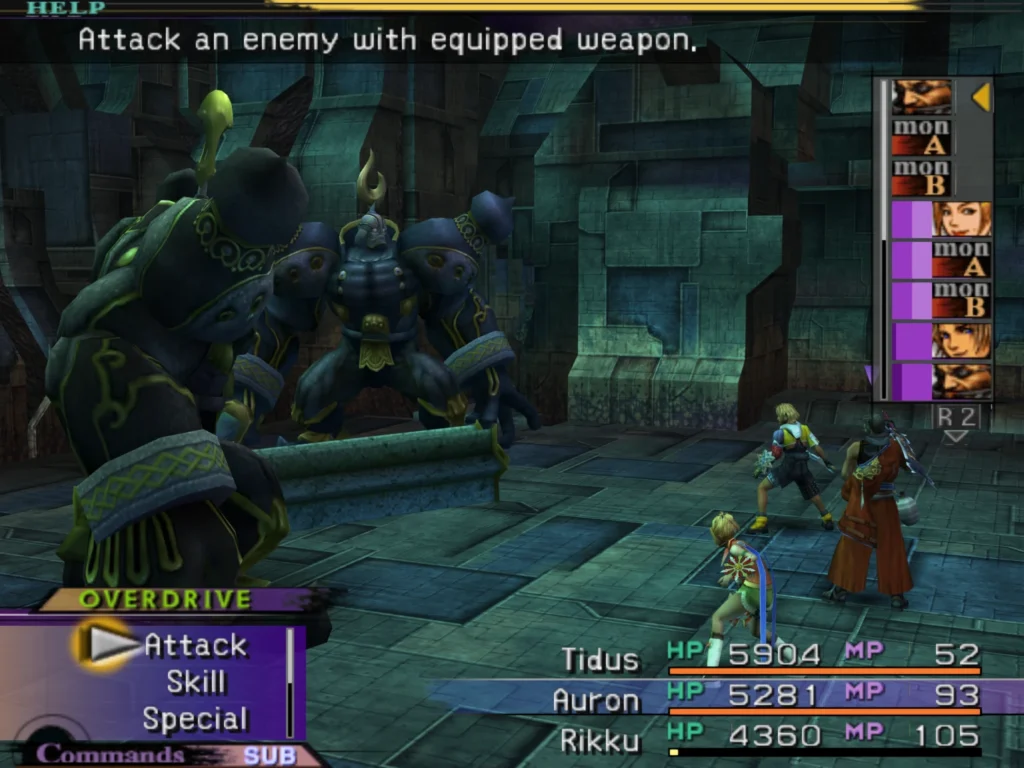
Battles are strictly random encounters. This was standard for the series up to this point, and honestly, I prefer this method. In typical fashion you’re whisked away to a separate screen wherein your characters are lined up on one side, and the enemies on the other. The ATB system is gone and this time it’s turn based with no time limits. Basically the game waits for you as you enter each command. These include the standard attack, magic, ability, etc. If you’ve played any Final Fantasy game up to this point then you know what to expect. This might however be the most polished turn based RPG I’ve played. It’s very fast flowing, and the animations are truly a sight to behold. Furthermore some encounters have context sensitive commands that allow you to interact with the environment. This kept boss battles in particular fresh, and added a lot of strategy.
One of the big changes made here is that you can swap characters out in the midst of battle, and this doesn’t even cost you a turn. Even Tidus can be traded out. In theory this is a great idea. Letting you switch party members freely allows players to change their strategies on a dime. Unfortunately the execution falls short of master class. Most enemies in Final Fantasy X are weak to either the weapon or skills of a specific character. The game places such heavy emphasis on this strengths vs weaknesses that to get anywhere (especially early on) in battle you have to use exact characters. For example, Wakka is the only character that can effectively target flying enemies with his weapon. Monsters like slimes are strong against everything except Lulu’s magic, and armored foes take pennies for damage unless against Auron’s long sword. So on and so forth.
What this means is that the game forces you to change characters. Often. Far too much in fact. I enjoyed using specific party members, but at nearly every turn I found myself forced to use those that I didn’t really like. What’s more is that only characters that participated in battle gain ability points (which is how you get stronger). What this means is throughout the adventure you’re going to have to use everyone pretty consistently. If you don’t you’ll probably hit a road block where the character the game needs you to use isn’t strong enough. One of the series’ strongest mechanics up to this point was choosing and customizing your party. Here you simply can’t. Well, you can, but you’re bound to get hung up if you stick with only the characters you want to use.
As I mentioned earlier each party member has specific abilities. These include things like magic, and special moves with varying effects. In the first half of the adventure these, for the most part, are unique to each character. As I’ve also mentioned everyone uses a unique weapon during combat. You’ll find upgrades, yes, but they’re all at least functionally similar to the base tool they start with. I really liked how unique each character is. They differ monumentally in stats, but the abilities can make your life a whole lot easier. You can experiment with these for stat boosts to your party, and detrimental effects on the enemies. So on and so forth. Whenever you get stuck there’s just enough different options at your disposal to try out an endless number of strategies. These are, in part, why the battle system is so special in this game.
Another change FFX made to the formula is with its eidolons. These are the creatures summoned by spell in battle. Instead of simply being a one-off cast the eidolon instead takes the place of your party during combat. They have their own sets of abilities, and are largely treated like unique characters. Personally I liked this. These monsters are generally stronger than any one character. They have their own stats such as hit points, magic points, attack, defense etc. When in a pinch you could completely turn the tides of battle by drawing one out. What’s more is that there’s several different ones. Many join Yuna’s arsenal through story events, but the more powerful ones are hidden away and distributed only by completing side quests. I really liked the eidolon mechanics Final Fantasy X introduced to the series and wish Square had built on the mechanic.
This brings me to the sphere grid. Final Fantasy X ditches the traditional experience points system and instead gives you a large board full of nodes. Although it’s ultimately one, each character has their own starting position on this. As you get ability points from battles you’ll gain sphere levels. With these you can move one character a singular direction on the sphere grid. Spheres can be placed in the adjacent nodes which offer different stat boosts and abilities to learn. Originally I found this leveling mechanic lame, and you know what? I still do. For the first half of the game the structure is basically set, and you can’t veer off easily without using rare items to unlock different paths. It boasts heavy customization, but that doesn’t really happen until you’re around two thirds the way through the adventure. Experience points and proper levels would have worked much better.
Unfortunately the sphere grid is too limited in the beginning of the game. As I said earlier characters are basically on a pre-set path, and you have to use valuable and rare items to get them off of it. When you finally get enough of these items to truly open it up there’s almost too much customization. One example I have is that in my latest romp through the game Yuna wound up learning all of the black magic on Lulu’s section of the sphere grid. Lulu was all but useless at that point. I maxed out Auron and Tidus almost too easily meaning even boss characters were mere pushovers. Character swapping barely mattered at that point because the game simply became too easy. I’m all for more choice, but it feels like the sphere grid is too limited and then too open. There’s no perfect balance at any point.
Square-Enix even messed with the way in which equipment works. They don’t provide traditional set stat boosts. Instead each piece of equipment has slots on it. These can increase specific statistics by percentage points, or add various effects to the character. While most tools come with pre-determined slots sometimes these are empty. At specialized shops you can spend items and money to customize them to your liking. If I’m being honest the entire mechanic just feels off. This is especially true given you cannot overwrite any slot. Because equipment deals in percentage increases once you reach certain milestones via the sphere grid these often make your characters significantly overpowered compared to the enemies. This is especially true later on in the story. I really didn’t care for the mechanic. This is another case where more traditional systems would have made the game stronger.
From start to finish Final Fantasy X took me around fifty hours to complete. That’s pretty standard for a role playing game of this era. While the main quest is rather linear there is an abundance of sidequests that can be completed. This will give you a leg up in the latter sections of the game, but honestly, you won’t need it. While the beginning of Final Fantasy X gave me a moderate challenge I found it became too easy about halfway through. That’s even with minimal leveling, and after completing very little of the optional content. I was pretty much able to throw out all strategy by the time I faced the final boss. The unbalanced nature of the game is caused both by the weird weapon system and the sphere grid.
Oh and I almost forgot. You can actually play blitzball in Final Fantasy X. At one point you’re forced into a match. After that it’s optional. Winning matches can yield good items so it’s worth it. Blitzball is best described as turn based soccer. Or Rugby. It’s underwater, yes, but that changes very little. You guide a singular character across the field with the ball and when contacting enemy players must input a command to proceed. Your success depends on the stats of your player vs the opponent. It’s really unique and surprisingly entertaining when you get the hang of it. What’s cool is that throughout the adventure you can recruit NPCs to your team. This is done by pressing the square button to interact with them. They each have their own set of stats, and can even level up.
Final Fantasy X was one of the best looking games available anywhere when it first released. It still looks beautiful even today. The character models are full of detail, and even clothing reacts to the environment. Some features might look blocky today, but this is barely an issue. I absolutely love the visual style. It’s part of what makes this title so immersive. It’s also bright and colorful which was becoming increasingly rare for the genre at the time. Final Fantasy X is still an absolute artistic and technical marvel even today. The soundtrack fares even better. Final Fantasy X sounds incredible. This is one of my favorite video game soundtracks of all time. For the music Square took a different trip-hop approach that works astoundingly well. Some of it even blends well with classic renditions of old Final Fantasy themes. I still regularly listen to this music.
