
Today we’re going to be dropping some truth bombs. Super Mario Sunshine was never very good. At least as far as the franchise is concerned. There, I said it. There’s just no comparison. This was a something that took me years to finally accept. Not only did I love the Gamecube console, but this was next gen Mario at the time. We hadn’t seen a proper new game in the franchise since the landmark Super Mario 64 in the generation prior. This just wasn’t it. Not only did the game feel more rushed and sloppy than Nintendo’s other titles, but the focus here was on a gimmick. It wasn’t one that made the platforming better, nor did it even fit in with what we generally expected from this franchise. With Summer approaching I decided to give this tropical platformer another go. Does it hold up? Let’s take a look.
Nintendo’s first mistake was putting so much effort into the story. This is Mario for crying out loud. We don’t want a five minute full motion video introduction. That’s what they gave us here. Mario, Princess Peach, and Toadsworth, and several other mushroom men are going on vacation to the tropical island Delfino. This paradise is home to the Piantas. They’re a peaceful fun loving folk. Soon after arriving Mario finds himself in a mess of trouble when he is arrested for vandalism. Someone who looks like him has been trashing the island, leaving paint everywhere. As punishment our hero must clean things up, and eventually bring the real culprit to justice. Hey, at least Nintendo tried something different here. That doesn’t mean I have to like it though.
At first glance Super Mario Sunshine appears to be a traditional Mario title. It’s a 3D platformer wherein you guide the character through a variety of different worlds, battling foes and overcoming platforming challenges. Delfino Island is the major setting here, and the town on it serves as a hub world of sorts. You can interact with various Piantas, look for hidden items, and even just explore. Mario is quite athletic so it’s always a blast to try and reach the tops of the highest buildings, or even just wall jump in the alleyways. Within the island are numerous portals that take you to the levels proper. Like in Super Mario 64 your goal is to collect items (instead of stars it’s ‘shines’ this time) within the stages to unlock the path forward. These have pretty specific objects and you’re given a one line clue from the onset.
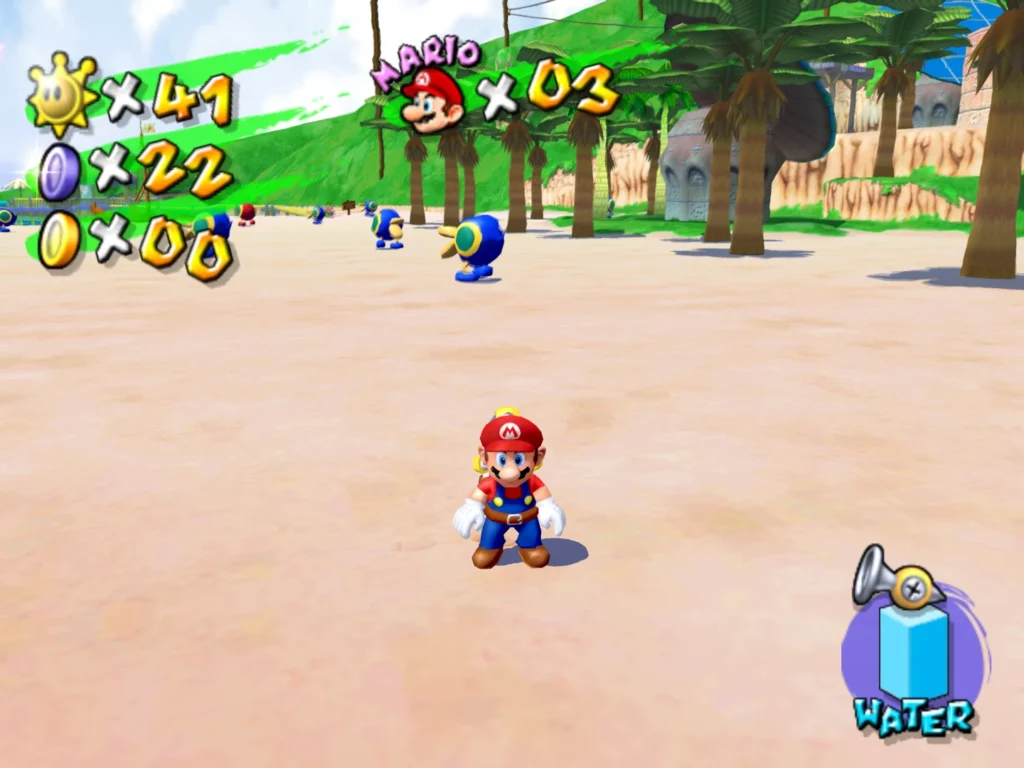
Does anyone remember the ‘clean is better than dirty’ ad campaign Nintendo ran for this game? Yeah, it didn’t do Super Mario Sunshine any favors. At the time Nintendo’s family friendly image was hurting more than it was helping them. This commercial just exacerbated things. It did get one thing right though. It described what Super Mario Sunshine is about in a rather simplified way. Our plumber is going to be cleaning. A lot. Thankfully he has just the right tool for the job. The gimmick introduced here is FLUDD. It’s a water pack that Mario wears on his back. It has several different functions but they all center around shooting water. Not only is this how he cleans up the goop littering the island, but also helps with dispatching foes and even helps him get around.
So what can FLUDD do, exactly? I mean besides just shooting water? This depends on the nozzle you’re currently using. In the beginning you have just two. These are the squirt and hover nozzles. The first let’s you shoot streams of water. This can be used to clean up paint, hurt foes, and even solve puzzles. You’re given two options for this; you can either run around while spraying water straightforward or stand still and aim the stream in any direction. Both of these come in handy in different situations. The hover nozzle has only one function, but it’s among the most helpful ones. This allows you to fire two streams of water downward to keep Mario in the air longer. He even slowly gains elevation. Each FLUDD nozzle can only be used for a short amount of time so you can’t simply hover endlessly throughout a stage.
The other nozzles are unlocked as you make it a bit farther into the game. See something high up but can’t reach it? You’re in luck! The rocket nozzle propels Mario straight upwards at high velocity significantly higher than he could ever hope to jump. Then we have the turbo nozzle. This has a similar effect, but on the ground. This fires Mario at high speeds allowing him to take out enemies and break barriers. As you may have guessed it these exist primarily to net you more shines. In particular in the Delfino Island hub. These nozzles make getting around more fun, but are often required for some of the trickier objectives. You an freely switch between them with a simple press of the X button. Sometimes you’ll have to do so on the fly.
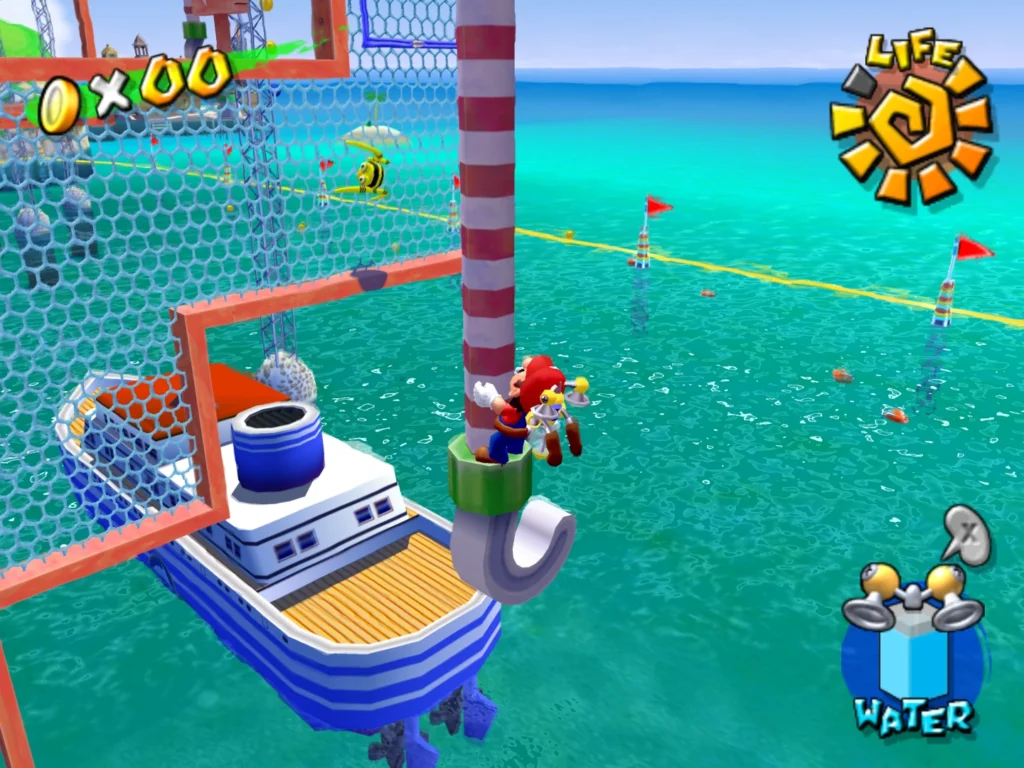
Unfortunately FLUDD doesn’t have an unlimited supply of water. You have an on-screen indicator to show how full his tank is, and when it runs out Mario can no longer use any of the nozzles. Refilling the water supply is easy though. You need only find a water source. Any will do. Considering the fact that the entire game takes place on an island that should be easy enough. Some enemies even drop water bottles for this purpose. With so many sources at your disposal, and the fact that it takes real effort to actually drain FLUDD you’ll never be out H2O for too long so it’s hardly worth saving it up.
My main issue with Super Mario Sunshine is that it’s too heavily based on this mechanic. FLUDD is basically the game. Sure, he can hop and slide like in previous Mario titles, but his ability to spray water takes center stage here. Mario’s platforming skills basically play second fiddle. Normally having a platformer based around a gimmick wouldn’t be a bad thing. That’s not the case here. Mario’s innate abilities made the platforming challenges fun in Super Mario 64. Here the stages are primarily based around FLUDD. It’s okay, but honestly, vanilla Mario is better. You can only spray so many enemies with water before it’s too much. There’s plenty of variety in obstacles and foes, but with the basic design being so focused around FLUDD it feels repetitive. That’s not normally a problem that this series has.
Next up we have the level designs. Again, these are too reliant on FLUDD mechanics. That’s not their only problem though. The stages feel really small compared to Super Mario 64. Some of them may be similar in size, but many of them feel too straightforward. I never thought I would feel claustrophobic in a Mario game, but here we are. They’re dense too. There’s sometimes too much going on at once. Exploration is fun, but this is no Super Mario 64. It also doesn’t help that almost all of these use the tropical theme. Normally water based levels would be among my favorite in any platformer, but it’s a little too much here. The setting didn’t afford the developers nearly as much freedom as they normally have. If you don’t like swimming in this type of game then you’re out of luck. Mario’s like a fish here.
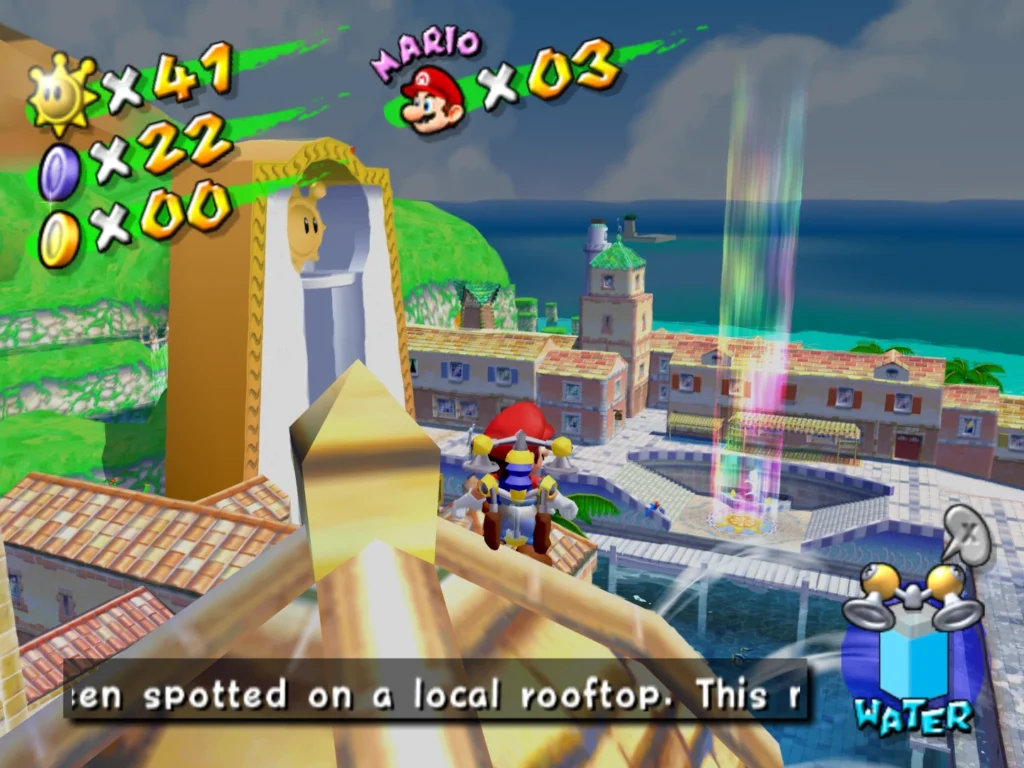
There are also aren’t a whole lot of stages in this game. The last iteration had, what, over twenty? This time we aren’t given even ten separate levels. That’s disappointing especially given the Gamecube’s large storage media. Considering this game has one hundred and twenty shines to collect it’s quite compact. Each stage has eleven which feels like overkill. Some of the challenges repeat between stages such as collecting blue coins. Each level also has one specific cave that switches the gameplay up quite a bit. At the beginning of these areas Mario loses FLUDD. It’s a pure platforming challenge. Honestly, these are the best parts of the game with moving platforms and endless pits. They are also the most challenging parts of Super Mario Sunshine. Honestly I would almost have preferred this be the entire game.
Unfortunately the controls are also a bit of a problem here. In a Mario game? Would would have thought? The little guy moves around easily enough, and he makes acrobatic jumps with ease. Even FLUDD has no major issues and the pressure sensitive shoulder buttons really shine. Unfortunately Mario loses his signature punch ability from Super Mario 64. Now he can only body slam foes, and I found myself accidentally doing this repetitively. It feels like sometimes you get stuck on the ground if momentum is working against you. Furthermore the camera is one of the worst in the series. You manipulate it with the C-stick, but it rarely goes stays where you need it to. I found myself constantly needing to re-adjust. Swimming is surprisingly stiff, but underwater challenges are uncommon. The controls aren’t terrible, but they gave me more issues than a Mario game normally would.
The only reason I’ve been so harsh on Super Mario Sunshine up to this point is because, well, it’s Mario. This was also the only traditional game in the series we got on the Gamecube, and it wasn’t even a launch title. The issues I’ve mentioned up to this point are annoying, but they don’t break the game. Super Mario Sunshine is still a fun platformer, and one of the best of its generation. I found myself wasting hours at a time simply exploring Delfino Island and jumping off of walls. It was a joy to discover secrets this way. Even the stages, when they aren’t forcing you to use flood, can be fun to explore. There’s a fantastic game buried underneath this less than compelling gimmick. Sometimes it shines through, and sometimes it doesn’t. Regardless Super Mario Sunshine is a fun time.
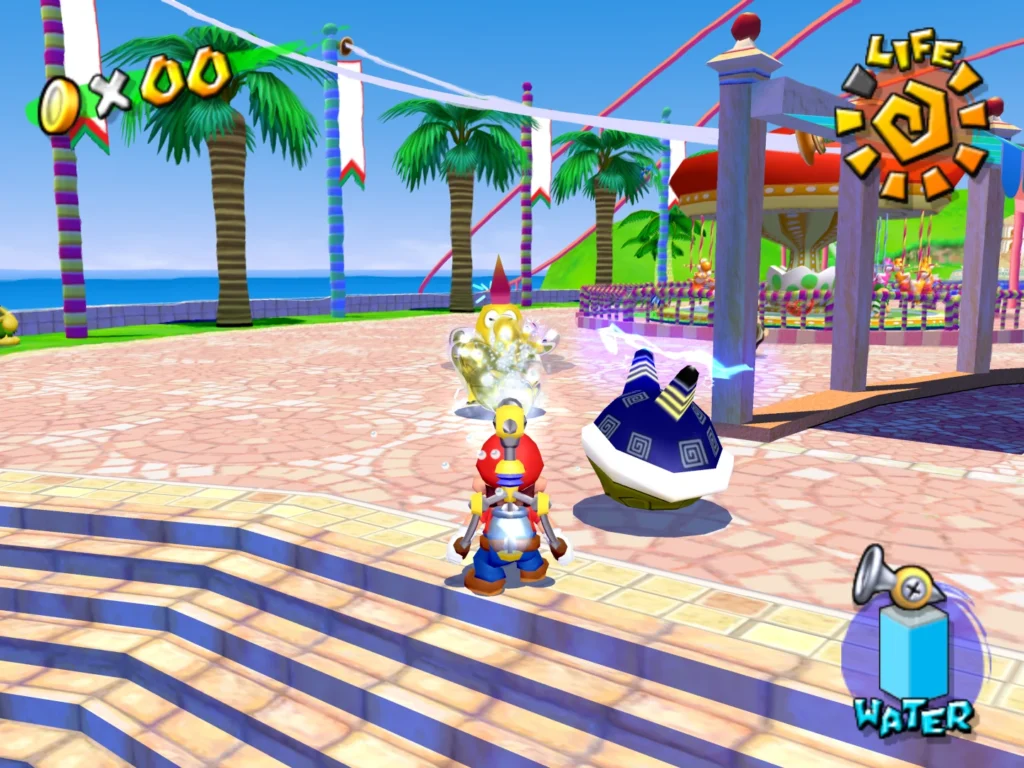
When it comes to graphics I’m a bit lukewarm with Super Mario Sunshine. The environments use really low resolution textures, and some elements look a little blurry. Mario’s model is a significant upgrade, but FLUDD kind of hides him a little. The absolute highlight here is the water effects. This game has some of the best looking water I’ve seen anywhere. As far as video games go that is. The heat wave effect is also really impressive for its time. It looks incredible considering how old Super Mario Sunshine is now. The draw distance is also rather impressive with full details in view from even far away. Unfortunately the soundtrack failed to grab me. It’s simple midi compositions that seem kind of generic. It doesn’t feel like Mario to me. Except for the acapella rendition of the original Super Mario Bros theme. That sounds incredible here.
