
It’s Halloween season. Know what that means? Splatterhouse. At least in my house. This old video game series was once considered the pinnacle of video game violence. Just look at its name. You knew it was going to be a bloody good time. It’s honestly a little tame by modern standards though. The series began in arcades, the original was ported to the Turbografx-16 console, and a sequel came out on the Sega Genesis. It seemed like there wasn’t much more of the envelope left to push. Namco wasn’t done though. Splatterhouse 3 came out and brought many changes to the franchise. Today we’re going to take a look at it. Here’s our review for Splatterhouse 3 on the Sega Genesis. Let’s check it out.
Splatterhouse 3 picks up five years after the conclusion of its predecessor. Rick and Jennifer have been re-united, married, and even have a child now. Our hero has retired from his days of gut splattering and is now a successful Wall Street firecracker. The past rarely stays where it belongs though. The monsters are back, and have now invaded Rick’s home. He must once again don the Terror Mask, power up, and send these ghouls back from whence they came.
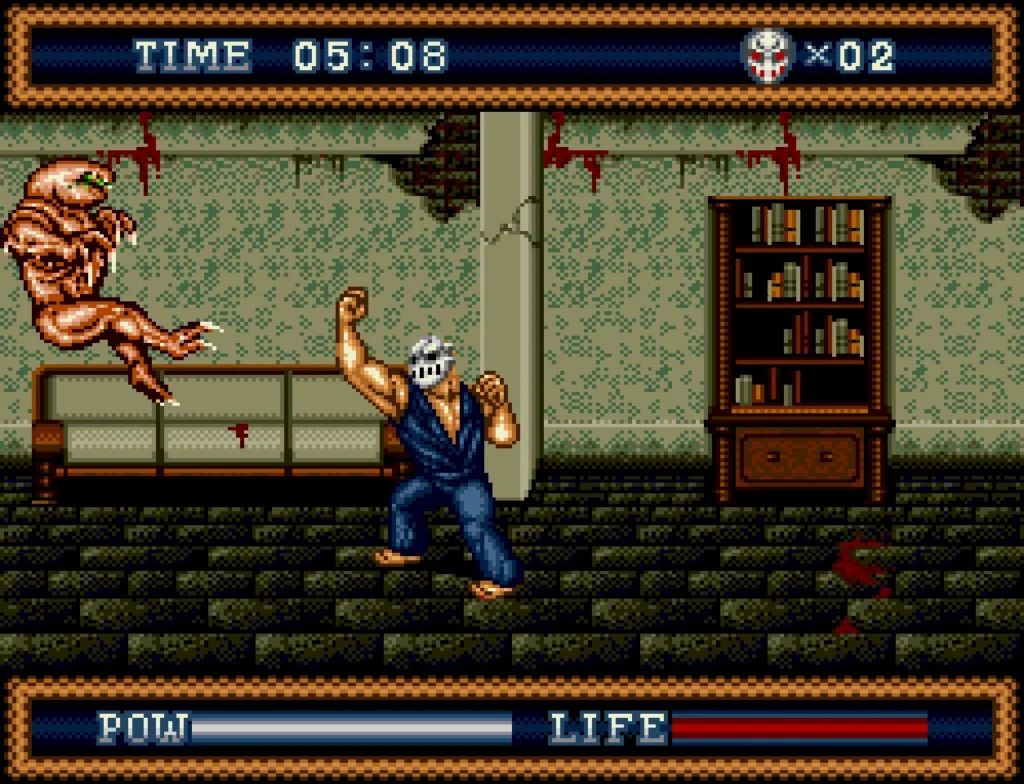
Yep, it’s Splatterhouse. Rick is either the most unlucky protagonist in video game history or Namco couldn’t come up with any new ideas. As far as the basic plot goes. They did up their game a bit. As you play through each stage you’re given small story snippets. These are surprisingly creepy, and hint at what’s to come if Rick isn’t able to complete the stage fast enough that is. We’ll get to the time limits later. Splatterhouse 3 is the first game in series to offer multiple endings. Some of them are pretty dark. It adds significantly to the atmosphere. In my opinion this is one of the most disturbing Splatterhouse games just in terms of scenario. That’s really saying something.
Once again you play as Rick, but what is old is not new again. Splatterhouse ditches the quasi platforming set up of its predecessors. It also doesn’t half commit to being a beat ’em up anymore. Splatterhouse 3 goes all in on the genre. It more closely resembles something like Final Fight or Streets of Rage now. That’s not necessarily a bad thing. It’s just different. From a side view perspective Rick can move in all directions instead of just left/right. He can perform combo strikes by pressing the attack button in repetition, jump kick, throw and even perform a multi-directional supermove. I imagine this was a little jarring for Splatterhouse fans at the time.
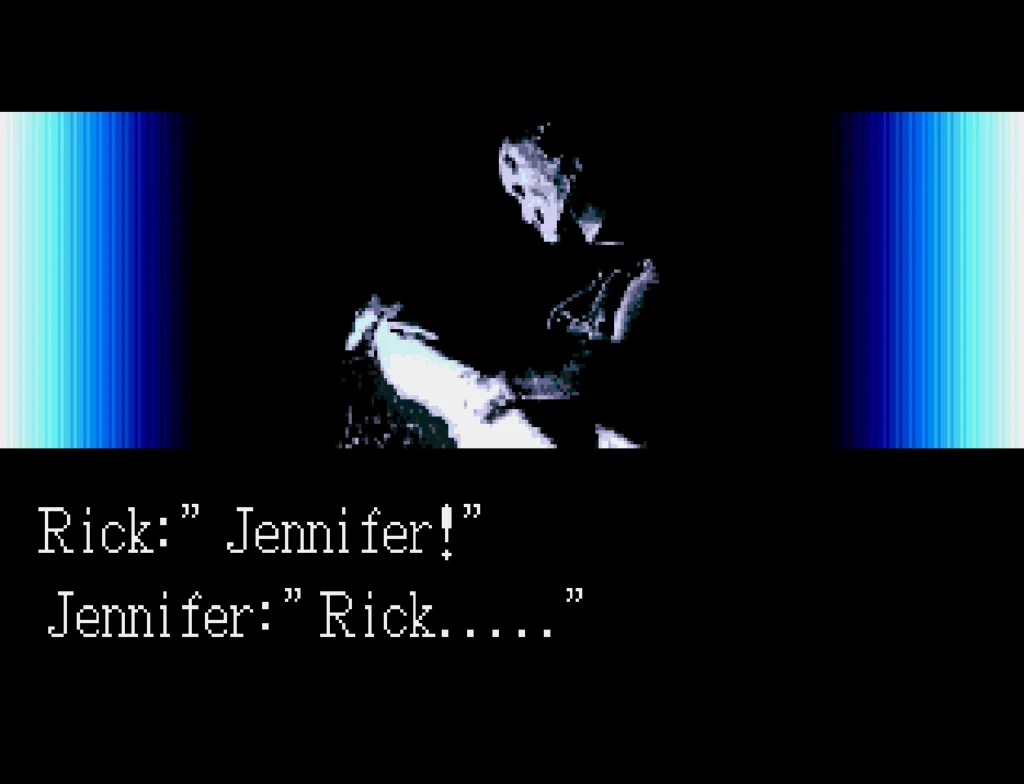
Progression is also non-linear now. Much moreso than in your basic beat ’em up title even. Each floor is comprised of various rooms, and many of them have more than one door. These open up once all enemies in the area have been defeated. You have access to a map showing the layout of the rooms with a red X marking where the boss resides. How Rick gets there is largely up to you. The game doesn’t pull any punches though. Not all paths are equal. Some of them are downright masochistic with stronger enemies or challenging hazards. Splatterhouse 3 rewards those who replay it because players can nail down the easiest and fastest paths to the end.
You’ll need that knowledge because there’s a timer constantly ticking away at the top of the screen. Usually you’re given between five and seven minutes to clear a stage. When this timer runs out the game doesn’t automatically end. Instead something horrible related to the story happens. You keep playing, but with the knowledge that something has gone wrong. For example, failure to beat the clock in stage two results in Jennifer being eaten alive from the inside out by a parasitic worm. Yes, it’s that dark. It makes the game feel incredible oppressive and foreboding. This is especially true when you’re given small story snippets between rooms that gives you information on what’s happening. Even though this is a 16-bit title I found it really disturbing in the best way possible.
The combat engine in Splatterhouse 3 is fantastic. Rick moves with appropriate weight, and his strikes feel really heavy. There’s fantastic feedback here. By default Rick can punch, jump kick, and throw enemies. It’s the basic set up for any beat ’em up. Punching in repetition results in an uppercut combo (think Cody from Final Fight). There’s also a super move that Rick can perform, but it requires a few directional inputs and the attack button. It took me a little while to figure out this one, but it’s very helpful. You have a life bar that depletes as you take damage, and when it runs out Rick loses a life and starts the room over. Splatterhouse 3 is very challenging. Generally you have between one to three enemies to contend with at a time, and they love to get on both sides of Rick.
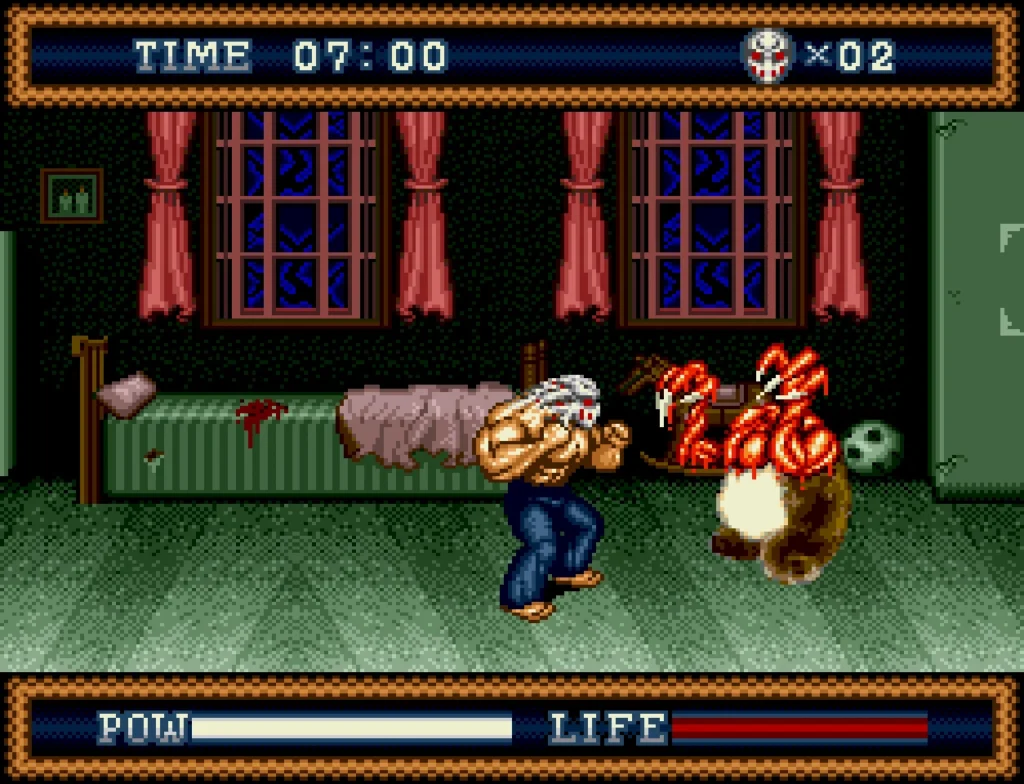
You’ll also find helpful pick ups as you play. This includes weapons like the classic two by four, meat cleaver, baseball bat, etc. There’s even a cinder block that can be thrown at enemies. When you’re hit Rick will drop the item, but in most cases you can just pick it up again. These are extremely helpful and not only increase your attack range but also deal more damage. Unfortunately there’s no chainsaw or shotgun here. That’s a major bummer. Other times you’ll find hearts (which recover health) and blue orbs (these fill your super meter). I wish there was something that added more time to the clock, because it can be difficult to beat the time limit.
The most interesting part of the game is that Rick can transform into a more powerful version of his former self. He gets bigger, moves faster, and dishes out more pain in this mode. You activate it with the A button, and it remains in play either until you clear the room or the power meter runs out. This is by far the most useful trick up Rick’s sleeve. It comes in handy not only in the more difficult moments, but also when the timer is ticking down and you’ve gotta go fast. It allows you to make short work of what would otherwise be a challenging room. I find it’s especially useful against the boss characters. It doesn’t make them a cakewalk, but this can be used to level the playing field.
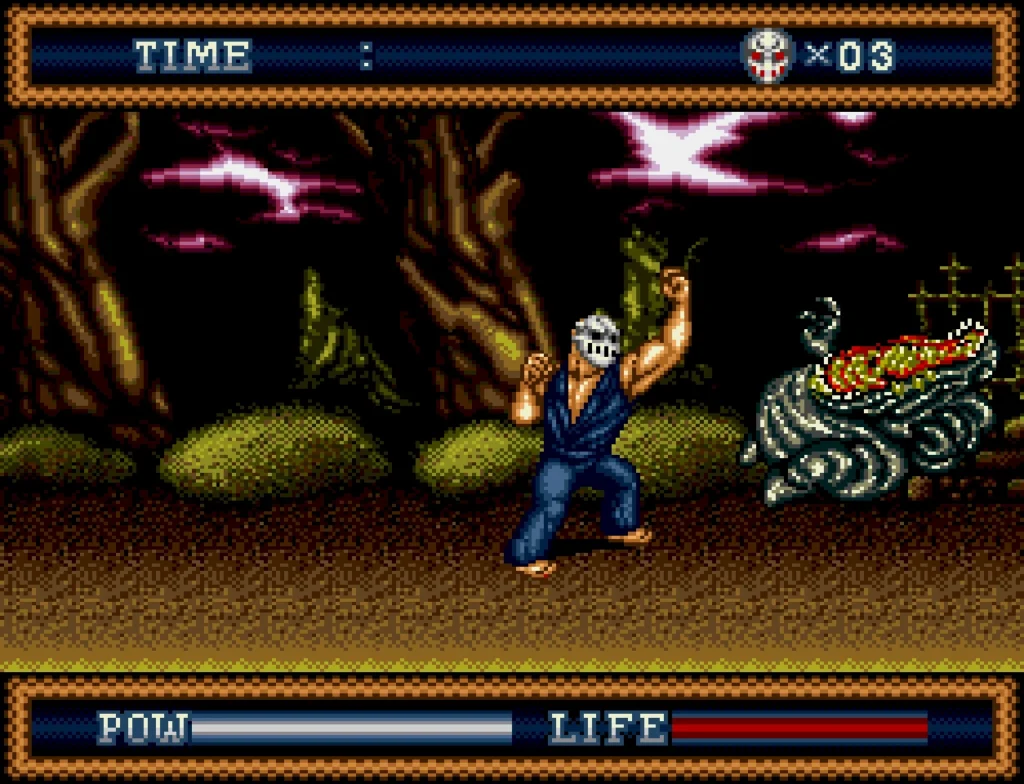
I love the game. There are some things that left me disappointed. Let’s start with the boss encounters. This has always been the high point of the franchise. They’re very underwhelming here. We get nothing as memorable as biggy man with his dual wielding chainsaws. Instead the bosses just tend to be bigger abstract monsters. In some cases they’re really weird. For instance there’s one encounter where you’re battling against a teddy bear that sprouts demon arms. In another case you’re tasked with fighting a blob. They’re still challenging, but lack the classic Splatterhouse imagination. Also disappointing is that there’s no two player mode. Being a more pure beat ’em up title you would expect multiplayer, but that’s not the case here. It’s a missed opportunity.
The big question is how does this game stack up to the other classic Splatterhouse games? It’s a departure, but still has the franchise’s heartbeat. It looks and feels like Splatterhouse despite not playing like it. If that makes any sense. I really love the non-linear structure here. Gameplay feels satisfying, and it’s difficult but not impossible. Moreover the time limit may be an optional mechanic to pay attention to, but it gave me a real sense of dread. That’s just perfect for a horror game. Splatterhouse 3 feels like an evolution for the franchise. That’s just what we needed after the second one was so similar to the first. It might be different, but this is what makes Splatterhouse 3 special. I still prefer the second one overall though.
Splatterhouse 3 is also an upgrade in graphics. Rick, and the enemies might have smaller sprites but Namco managed to cram more details into them. The animations have also been improved as well. The backgrounds tend to be a bit more boring though. Rick’s house is not as interesting as the West Mansion. I suppose that was unavoidable. Still, there’s a lot of detail here, as well as different designs for the rooms. It looks really good. I also never found a moment where the game suffers from slowdown. That’s very impressive for a 16-bit title. The soundtrack is a downgrade though. The compositions are good, and they sound decent, but the music itself isn’t as memorable. It’s Splatterhouse so it had big shoes, and this game just didn’t manage to fill them in the music department.
