
Pilotwings was a brand new original game released for the Super Nintendo at launch. I remember playing it a few years after it came out and it didn’t seem like anything special. The thing is I had already been exposed to mode-7 graphics. It was no longer all that special. Mode-7 graphics are the entire gimmick here. At the time this was a revolutionary rendering method. It made things look 3D at a time when we weren’t used to that. Because of this even some early Super Nintendo games looked almost a generation ahead from what was on the competing Sega Genesis. It really was that significant. I decided to return to Pilotwings to see if it’s still worth playing, or if the game is nothing more than a glorified tech demo. So how is it? Let’s take a look.
In Pilotwings you play as an unnamed fledgling pilot. Your simple goal is to earn various licenses by completing events that have you flying various vehicles. Pretty simple, eh? There’s no overarching story. Just a series of characters that provide hints to obtaining the next license at each level. These guys have very little personality and are just meant to push you forward. Your character lacks both a name and a face. It’s intended to be the player, so I guess that’s okay. It just makes Pilotwings feel a little rushed and devoid of personality though.
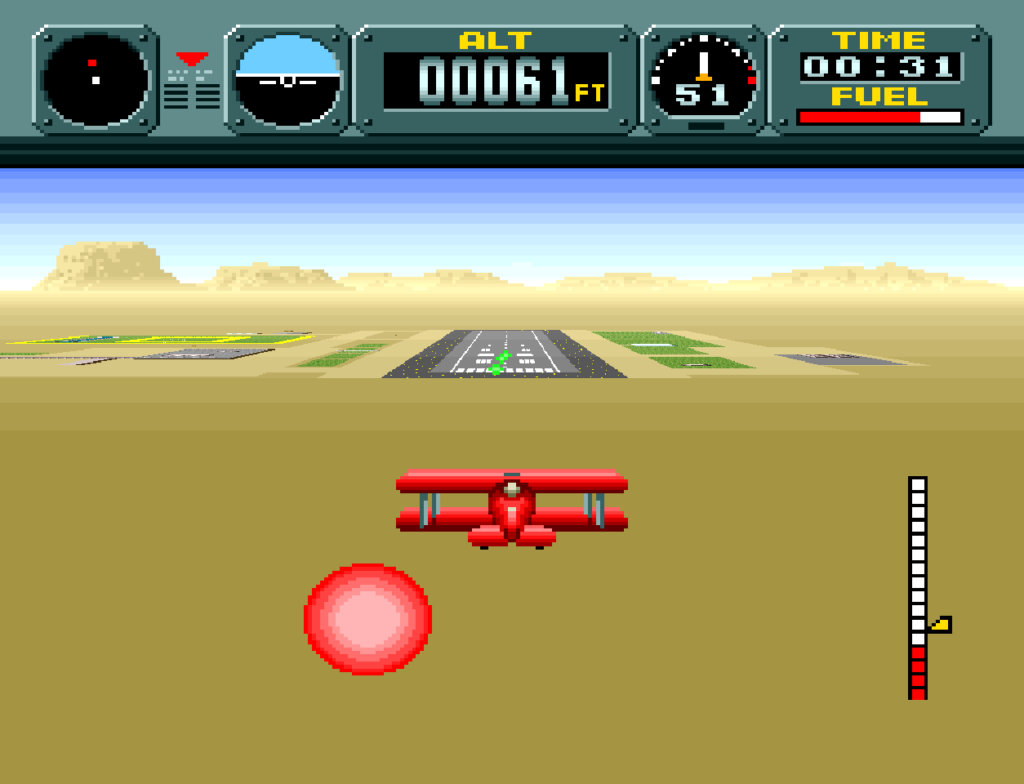
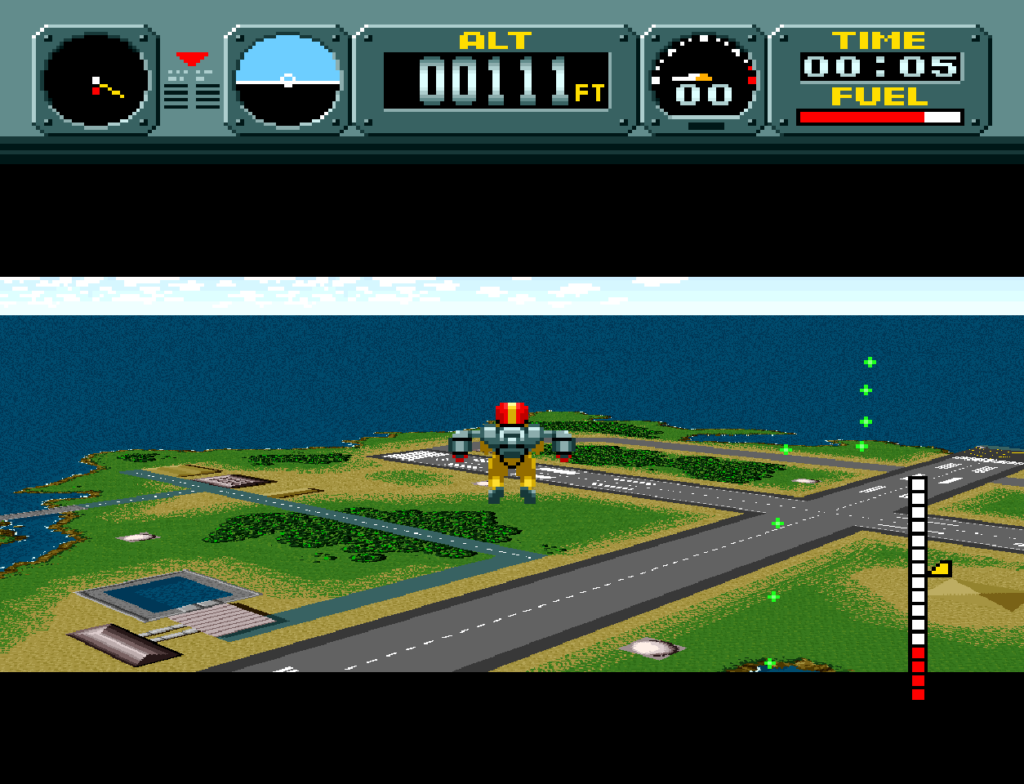
The goal in Pilotwings is to complete various events at different license levels. Each event uses a different vehicle, and there are four different options for these. First you have the light plane. This is your typical biplane and your goal is always to fly through floating rings and then successfully land the craft on a runway. Next up is skydiving. The basic premise is the same with you traveling through rings while in freefall. When you reach a specific elevation you can activate your parachute to slow your descent. Each map has specific targets you’re supposed to land on, and they’re designated with different point values. This brings us to the jetpack. Your character is strapped with jets and again, must fly through rings and land at specific targets. Finally there’s the hang glider. It too involves flying through rings and coming down in the right spot.
Let’s take a deeper look at each event. We’ll start with the light plane. This one just isn’t very fun in my opinion. The mode-7 graphics don’t work that well for objects displayed vertically. Often I discovered too late that I was too low or high to get the points for flying through a ring. It’s also really annoying that you cannot gain elevation back after losing it. This one requires far too much precision for a kid’s game. If you go too low at any point with the biplane then you lose all chances of successfully landing it. The fact that you cannot fly upwards is absurd. This makes the biplane events unbalanced compared to the others in my opinion. It also feels like you have the least overall control in these segments. The light plane was definitely not my favorite event here.
Skydiving on the other hand is quite a bit of fun. Before activating your parachute it feels like you have minimal controls. This is skydiving after all, and it at least feels realistic. You have the ability to tilt your character in a full circle. Aiming your head downward increases speed, and flattening out slows the descent. Once your parachute is out you’re automatically moving forward always. You can however steer. This event is quite the challenge due to the fact that you’re always in forward motion. You have to master the act of moving in circles while keeping an eye on your current elevation. Skydiving is challenging, but it never feels unfair. This is one of the best events in the entire game.
Next is the rocket pack. This event gives you by far the most control over. You have two options for thrust; either strong or light. Naturally you fly straight up when activating these, but holding forward on the directional pad aims the jets behind your character. This causes you to move in the direction you’re facing. Your goal here is to fly through rings as usual, and when complete you’re given targets on which to land. This one is a blast and is the easiest to learn, but most difficult to master. Unfortunately you’re limited to only a specific amount of fuel. That means you can’t simply fly forever. This limitation makes the action a little more focused despite basically being able to go anywhere. Using the jet pack to cruise around the four stages is a ton of fun.
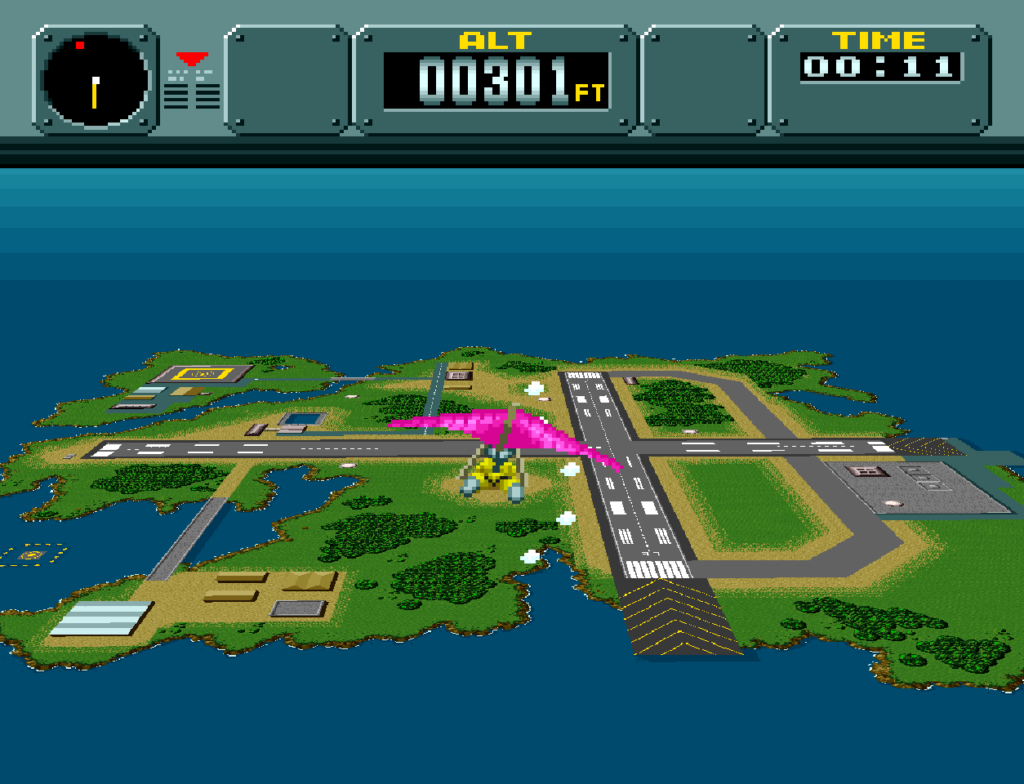
Finally we have the hang glider. This one controls like the bi-plane, but with a few differences. You’re perpetually losing elevation and constantly moving forward. The gimmick here is that you can catch wind streams coming out of the ground to raise you up a bit. You’ll need to do so in order to reach many of the rings. This often means doubling back to hit one, and sometimes multiple times if a ring is out of reach. This event is… okay. It has some of the same issues as the light plane, but it’s more manageable thanks to the ability to fly upwards using the wind currents. The basic controls also feel a bit more direct and forgiving. I had less trouble turning around in the hang glider as opposed to the plane. That’s something at least.
One thing I really like is that after the first license tests each course is designed around the specific vehicle. This means that there’s some overlap, and it’s fun to try sky diving and get a heads up on where you’re later going to need to land the plane. Sure, it’s recycling assets but in this case I didn’t care. The events are so different from one another it doesn’t feel repetitive. What’s also neat is the fact that you have to complete three events per license test, and reach a specific score overall in order to move forward. This means that you have a good idea of how you’re going to need to perform in the next event to be successful. What’s disappointing is that there’s no battery backup for saves. Pilotwings instead relies on an archaic password system. Thankfully it’s just numbers in this case.
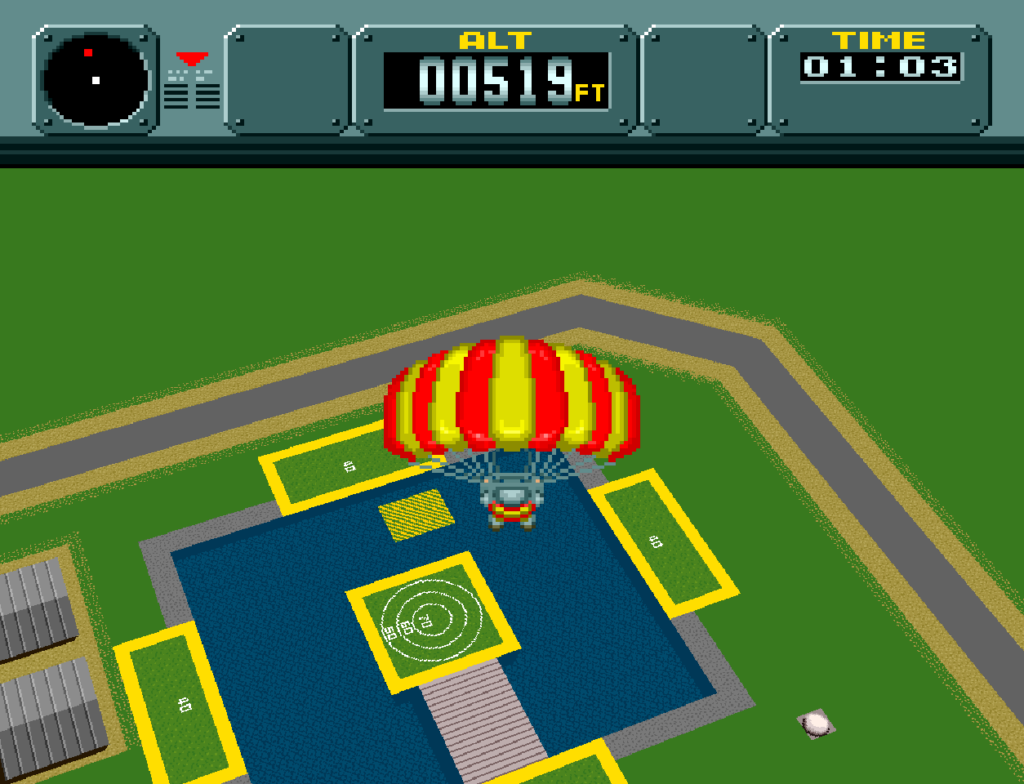
I’m sure that Pilotwings was quite the looker when it first released. You know, before we all got so used to mode-7 graphics. Now it just looks like an early Super Nintendo game with environments that lack detail, and over-use of the aforementioned graphical effects. With that out of the way Pilotwings is still perfectly playable today. The graphics scale extremely smoothly. You’ll never miss a landing or a ring because of poor scaling which is really nice. You can even switch viewpoints while using the rocket pack. This feels really forward thinking because a feature like this wouldn’t be commonplace until the next generation. Unfortunately the soundtrack is kind of weak. While each track is bouncy and upbeat the music is ultimately forgettable. A couple of short voice samples would have gone a long way here, but alas, we’re left with nothing but lackluster audio.
