
I don’t really have a lot of nostalgia for PaRappa the Rapper on the Sony PlayStation. The rhythm genre simply didn’t appeal to me back then. My first exposure to this title, like most people, was via a demo disc. I remember thinking how weird it was. Very little about the game made any kind of sense. I suppose that was the draw. The gameplay didn’t hook me. The soundtrack however just from that first stage has stayed in my mind all of these years. That’s part of the reason why I recently decided to give Parappa the Rapper a fair chance finally. Does it hold up? Sorta. Let’s check it out.
Let’s start by talking about the game’s art style. It’s one of Parappa the Rapper’s most distinguishing characteristics. The graphics are rendered in full 3-D, but the characters are cartoonish anthropomorphic animals. Their models are paper thin. Think Paper Mario. That’s part of what turned me away in the first place. Now that I’m older and not as easily overwhelmed by weirdness I think it’s charming. In this game you play as a young dog teenager named Parappa. Funny how that works. He’s an aspiring rapper, but suffers from a host of insecurities. Our guy is trying to win the affections of a young lady named Sunny Funny. You can’t make that kind of stuff up. Through music you’re tasked with helping Parappa build his confidence while he learns everyday tasks.
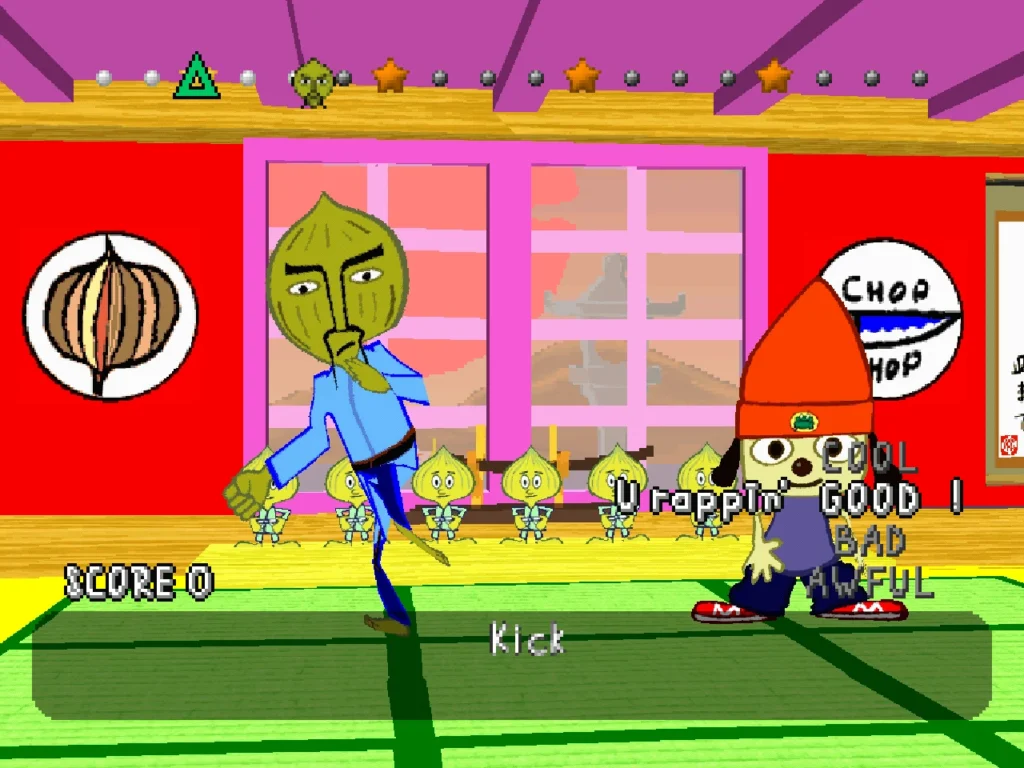
This is all very unconventional to say the least. The scenario is very basic with simple themes, but the game itself has a lot of heart. The story is told mostly through full motion video with rhythm based gameplay sequences in between. As I mentioned Parappa uses music to learn everyday tasks. These are the stages. The first one has our protagonist learning karate from a master of martial arts. He’s an onion. Yes, you heard that right. Next he will jam out with a driving instructor as he learns the rules of the road to get his license, then get the basics of earning money at a flea market, etc. The thing is none of these sequences feel very cohesive. It bothered me at first, but by the end of the adventure I didn’t care. Parappa the Rapper is not a game to take seriously. It’s fun, and funny.
Now we get to the gameplay. As I mentioned Parappa the Rapper is a music based rhythm game. At the top of the screen you have a bar where an icon (represented by the protagonist’s head) moves from left to right. In this area you’ll see icons representing different face and shoulder buttons on the PS1 controller. You just need to press the corresponding key when the icon moves over them. It’s simple really. To aid players the teacher in each stage will rap the verse first. This helps you get the rhythm, and see which buttons will need to pressed in order.
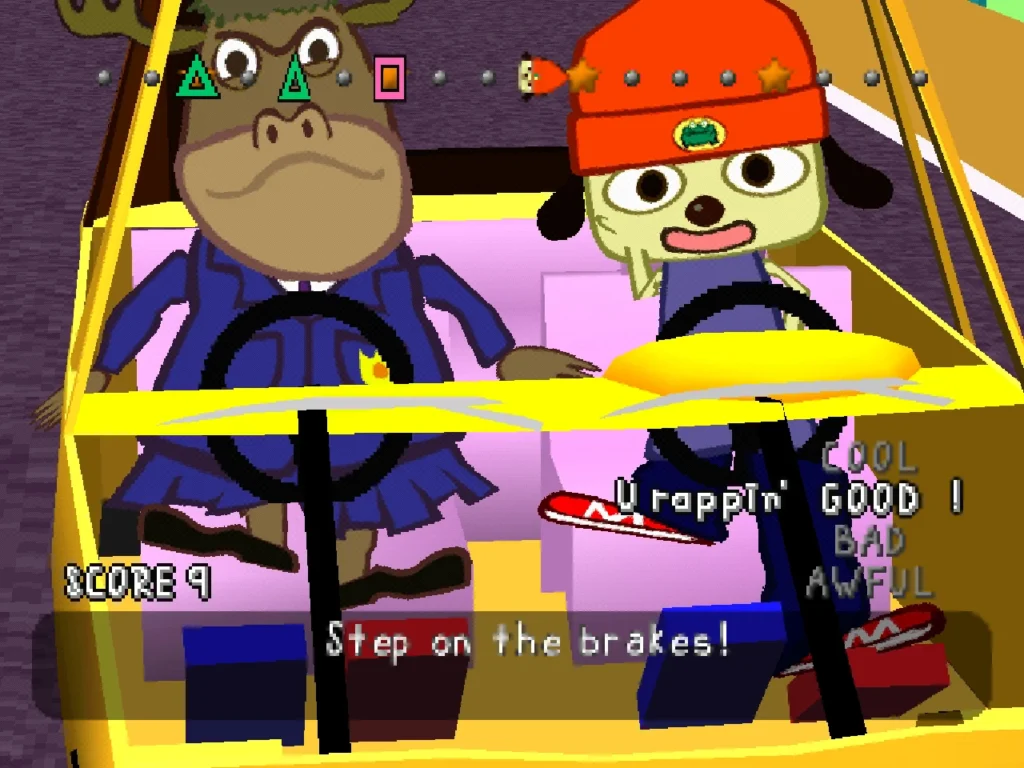
Each button corresponds to a different word or phrase, and Parappa will rap these lyrics as you press the corresponding key. This provides the player immediate audio feedback on whether you pressed the right one, and if your timing was correct. Parappa the Rapper does a great job of easing players in. The first few stages have just a few buttons on the bar at a time. Later on things get more complicated. You’ll have to press buttons in quick succession, and a second bar (just below the original one) will also be put into play.
Your performance is rated by the ‘U Rappin’ meter which has four rankings. You have cool, good, bad and awful. Anything below good at the end of a song results in the player being unable to progress until they try again. And that’s the entirety of how this game plays. Honestly there isn’t a whole lot to Parappa the Rapper. In some ways that’s a strength. It’s fun to play in short bursts, and easy enough to grasp that even younger players can jump right in. Unfortunately there just isn’t a whole lot to it. The game uses only the face and shoulder buttons. No dpad inputs here. The player’s left hand is only used for pressing the L1 key during gameplay. Even for the time that’s really simple for this genre.
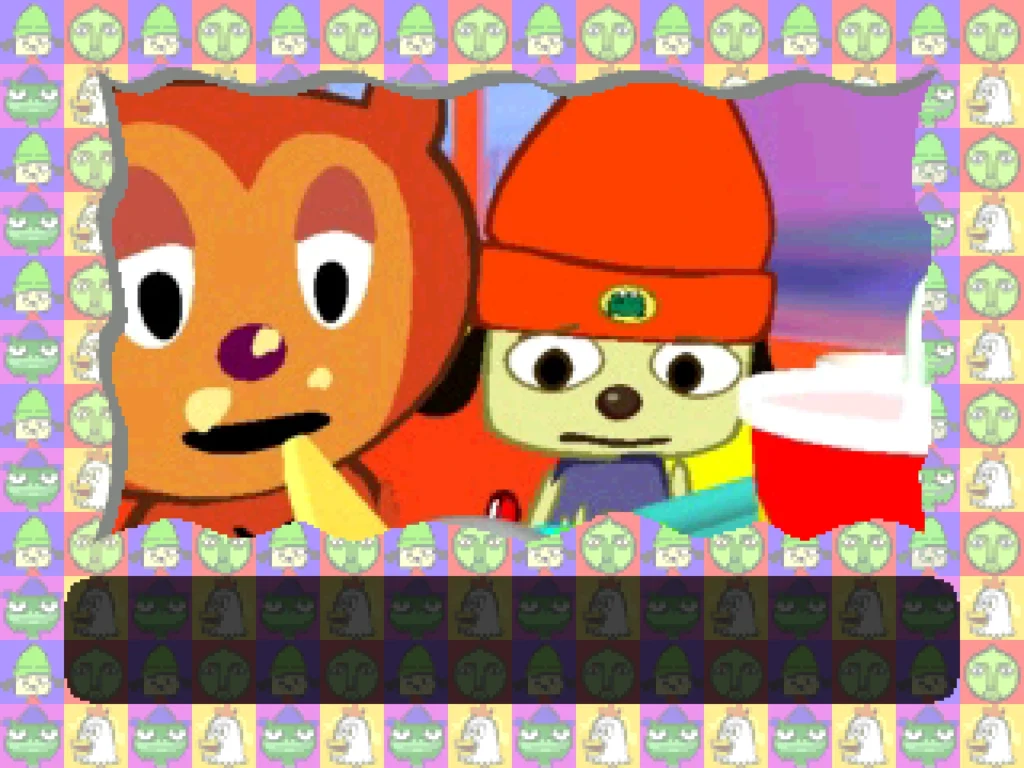
In my first playthrough I was able to complete the game in less than an hour. That’s with watching all of the full motion video sequences. The game has only six stages after all, and lines are frequently repeated within each one. There really isn’t enough content in this package. You have two difficulty modes, but easy is too simple to be any real fun. There aren’t any other modes of play rather than the main game. Sure, there’s a freestyle option but that has to be unlocked via a cheat. It’s mildly entertaining but gets old. Fast. The biggest surprise is the lack of multiplayer. Parappa the Rapper needed something, anything, added to it. I can’t imagine paying full price for this one even back then.
At least the controls are responsive. Heck, they better be what with the limited inputs and all. Even with multiple playthroughs I didn’t notice a single instance of input delay. The primary challenge comes from the fact that Parappa the Rapper doesn’t hold your hand. The inputs aren’t often close to each other. I had to train my brain to make some of them work. That’s especially true when it came to the shoulder buttons. These aren’t in play as often as the face inputs, and so whenever the game threw one at me I found myself struggling a bit. What’s more is that inputs are often located at the beginning of the bar. This means you’ll have to track the rhythm to make some of the early ones work. It sounds frustrating, but I found this aspect fun.
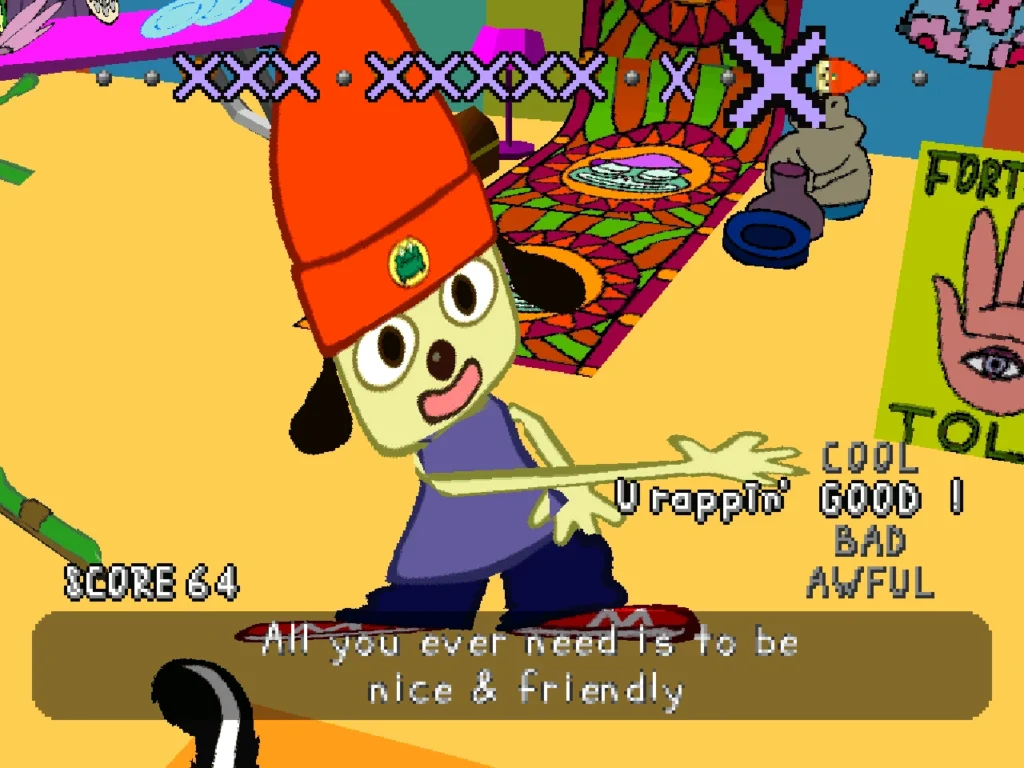
The graphics in Parappa the Rapper were a major sticking point for me when I played the demo all those years ago. You know what? I actually really like them now. The paper style for the characters looks really impressive for the hardware. Heck, even the anthropomorphic animal designs are charming. It’s all wrapped up in a vibrant and colorful world too. For a PS1 game the visuals have aged remarkably well. Even the framerate holds steady. This is particularly impressive during the camera transitions and movement. The only thing that looks bad these days is the full motion video. That’s to be expected though. Overall the graphics still look really nice.
Parappa the Rapper features one of the catchiest soundtracks of its time. After all I remembered word for word the lyrics from Chop Chop Onion’s Rap over twenty years ago. That’s with only playing the demo disc a few times. The rest of the music ranges from decent to great. Some of them, in particular Instructor Mooselini and Cheap Cheap the Cooking Chicken didn’t grab me. They almost sounded a little out of sync at times. On the other hand I doubt I’ll ever be able to get Prince Fleaswallow’s stage music out of my head. The only downside to the soundtrack is there isn’t a lot of range in it. You have pretty much hip hop and reggae. I guess that comes with the territory though. Rhythm games live and die by their setlist. This one is enjoyable, but it desperately needs more tracks. I was hungry for more.
