
The game we’re talking about today is not a good one. It’s not bad though. It’s just painfully average in just about every way imaginable. I’m talking about Blockids on the Sony PlayStation. What’s weird about this game is that it came out in Japan in 1996, but Western shores didn’t see its release until 2003. So why the hold up? I’m just guessing that Natsume needed to release something, anything, so they picked the easiest game from the heap. Regardless more games is never a good thing, and after spending a few hours with Blockids I wanted to talk about it. Let’s get right into the review.
Blockids is not unique. It’s a Breakout/Arkanoid clone. That’s not a bad thing because those games are good. Basically, you guide a paddle at the bottom of the screen moving it either left or right. The action takes place in an enclosed arena with various destructible blocks at the far end of the screen. Your goal is simply to eliminate all of these bricks in a stage, and you do so by deflecting a bouncing ball with the aforementioned paddle. Easy, right? If the ball reaches the bottom of the screen you lose a life, and when all of these are spent and continues exhausted it’s game over. Things get difficult fast because the ball speeds up with each brick you break. It’s premise is simple and easy to understand. So where does Blockids go wrong?
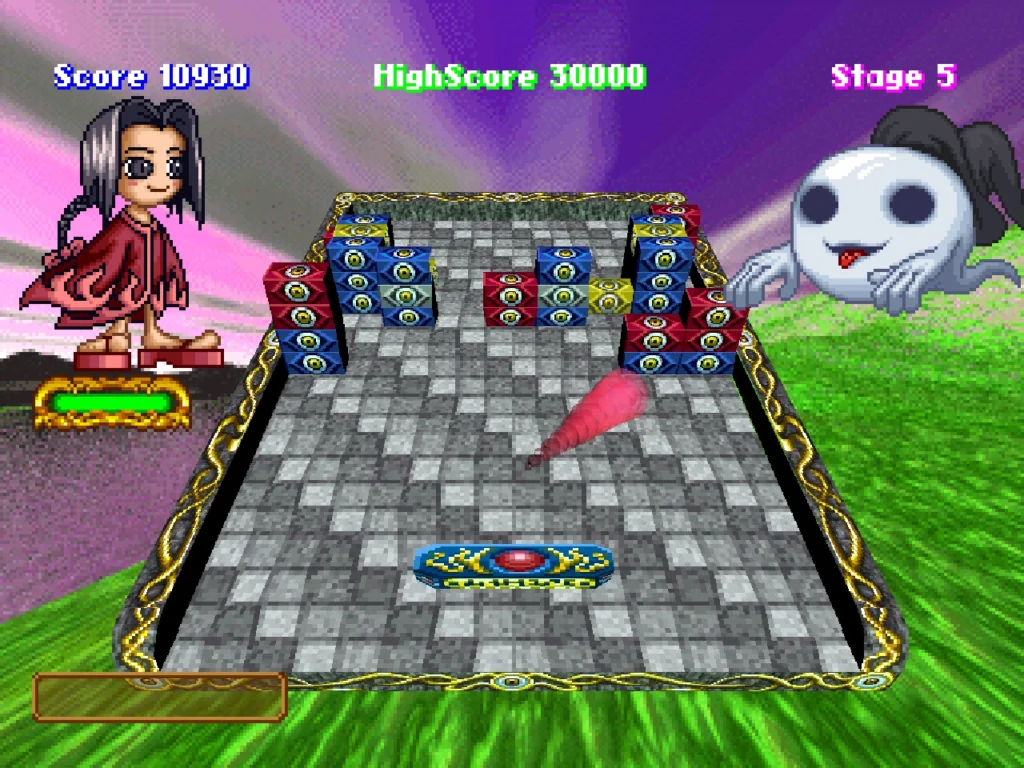
Unfortunately, Blockids is too simplistic. Sure, I’m willing to give similar games like Alleyway on the Game Boy a pass in this area. So why not this one? I think it’s fair to expect more from a PS1 game. This is especially true for one that released in 2003. Blockids isn’t without its special features but these feel either derivative or pointless. The major gimmick here is the use of 3D graphics. While this may have been exciting in 1996 I’m sure no one cared when Natsume finally got around to translating this game. You can choose from a variety of different camera angles. You can go with the classic overhead perspective, or a few different forward facing angles. There’s even a behind the paddle viewpoint. This just wasn’t impressive enough, and the top down POV was the only one I even bothered with.
Next up we have the fact that the bricks can be stacked on top of each other. When you eliminate one those resting on it fall to the ground. It’s difficult to even notice this from the top down point of view, but that’s the only one I had any success with. It’s counter intuitive. The developers attempted to push the premise by including a gimmick where you can make the ball bounce by pressing the X button. This is not limited in any way during gameplay. Use it as much as you like.
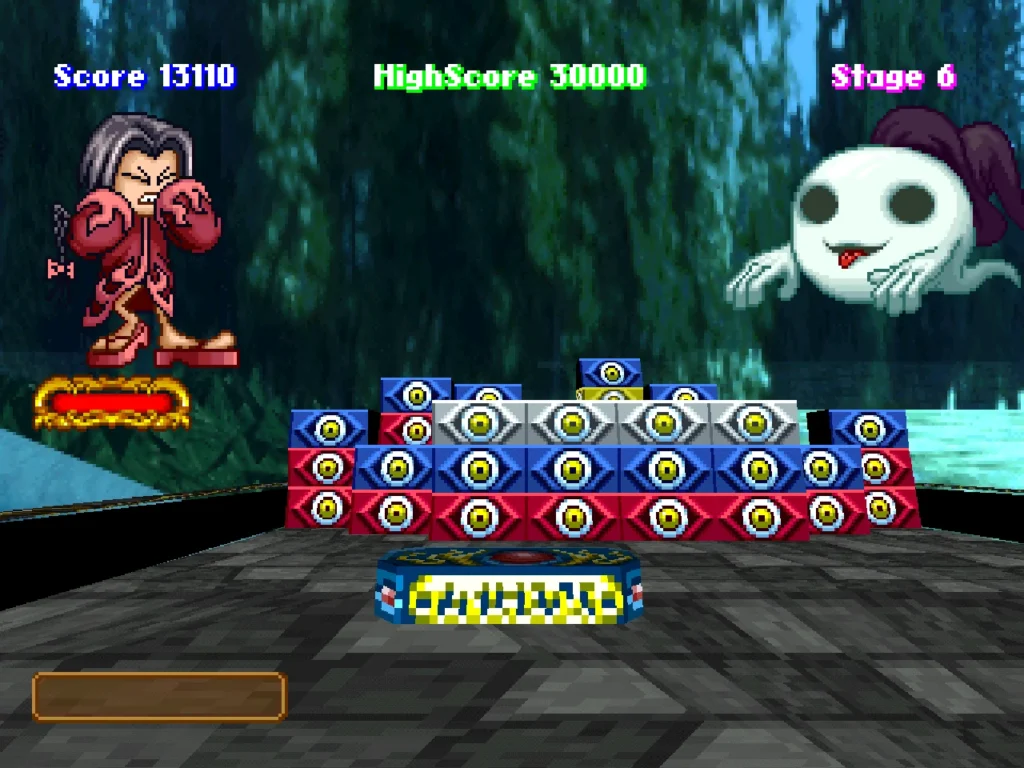
While this can be useful for getting the ball behind walls of blocks it felt weird in play. Plus, if you press the button as the ball is changing directions it will launch the thing in the air toward the bottom of the screen. The paddle is flat so you can’t hit an airborne ball. It’s use is diminished, and the gimmick itself is strange in the first place. It seems to me like it would have better served as a power-up rather than an unlimited ability.
The game also offers a host of playable characters. Eight to be exact. So what’s the difference between these guys you may ask? Not much. They have different on-screen character portraits, but the paddle remains the same color no matter who you pick. Oh, and they each have a special ability. This is dictated by a power meter on-screen, and it fills up as you eliminate blocks from play. The ability is triggered automatically but only lasts for a matter of seconds. Or until the ball reaches the bottom of the screen. Whichever comes first.
These range from things like increasing the paddle size, making the ball stick to the paddle so you can launch it at will, to adding power to the ball so it instantly breaks through everything in its path instead of bouncing off. Actually, that’s all of them. The characters share abilities. They can be useful (some more than others) but it’s lazy that everyone doesn’t have a unique one. You also have standard power-ups released from broken blocks that fall to the bottom of the screen. Some have positive effects and others negative outcomes. These affect your paddle size, move the paddle forward or backwards, give extra lives, etc. One even clears the entire stage for you.
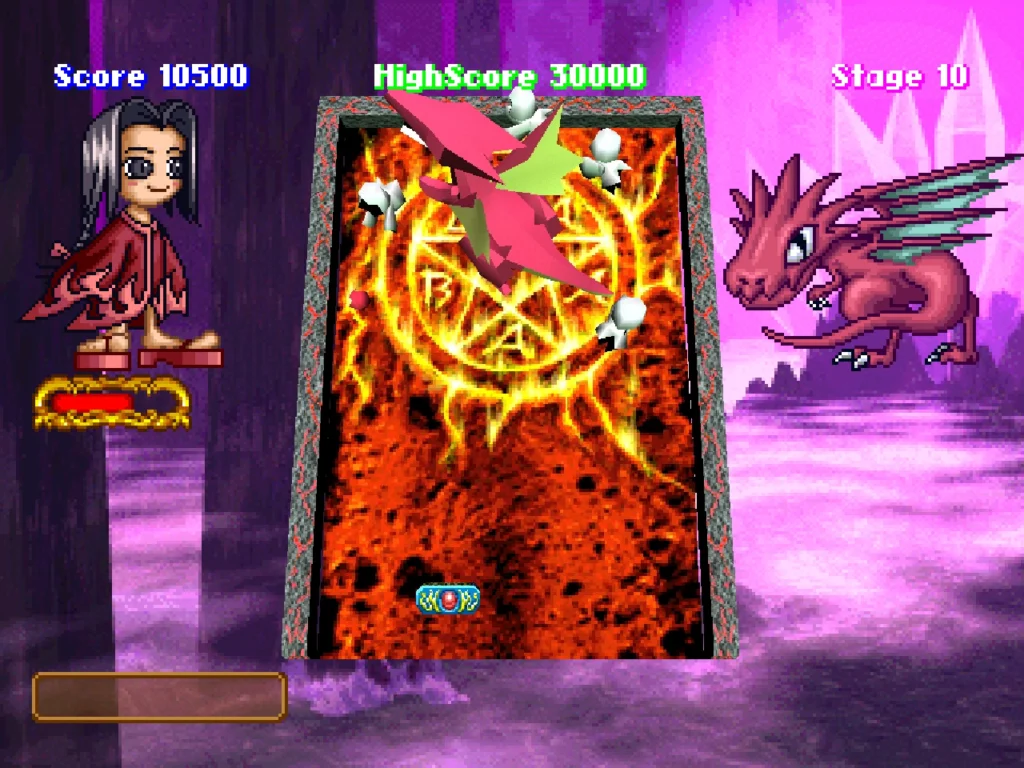
Even after hours of play I couldn’t tell which power-ups did what. That’s a problem. They’re all pill shaped but differ in color and symbol. There’s too many of them to keep track of. The fact that some of them make playing the game more difficult led me to just avoid them altogether. It’s better to be safe than sorry. Why even include detrimental power-ups in a game like this in the first place? The falling pills are easy enough to avoid. It just steers players away from taking advantage of the mechanic.
Another problem is the controls. I had to look them up because I was sure there was a way to slow down or speed up the paddle movement. Supposedly this is done with the shoulder buttons, but after multiple attempts I didn’t notice a difference. What I did find is that the speed seems to be automatic. When the ball is far away your paddle zooms left and right, but it slows down considerably as the ball moves close to the bottom of the screen. This took some getting used to. Eventually I was able to make it work, but a game like this shouldn’t have a learning curve. The controls have no business being so counter-intuitive here.
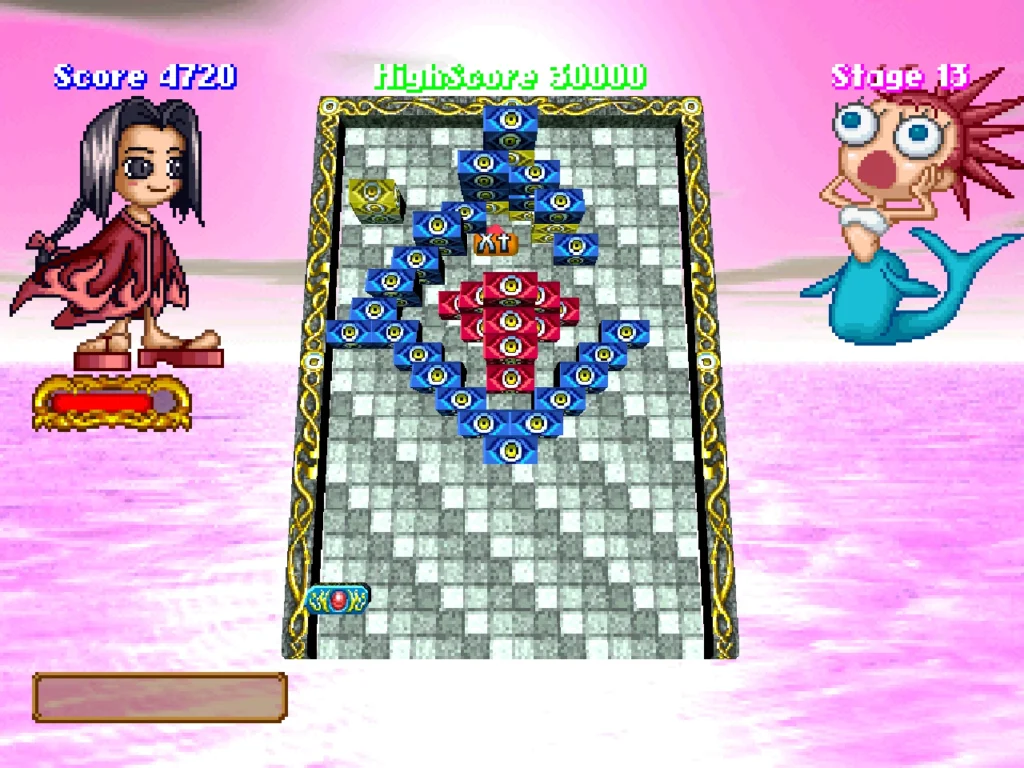
Blockids is also lacking some key features from other similar games. It has only two game modes; adventure and challenge. That’s right, there’s no multiplayer. What the heck? Adventure mode offers 50 levels of play with a boss encounter every ten stages. These fights are more interesting than the standard stages and feature moving parts and a character you have to damage by hitting with the ball. Simple enough, right? Challenge mode has its own unique set of one hundred stages. The major difference here is that you have unlimited continues. That doesn’t make much sense to me. Where’s the challenge in that? While the game has a lot of levels the lack of multiplayer is a sore omission.
The game also isn’t very pretty. The play area looks nice enough. It’s easy to tell the bricks apart, and you have a decent view of the action (provided you’re using the overhead perspective). The framerate remains steady as well. The problem is that with stacks of blocks it’s easy to lose track of the ball sometimes. Everything is rendered in polygons, and the models look well enough. The textures unfortunately suffer from that classic era PS1 pixelated look. What really bothers me though is the character portraits. Their designs are weird. I didn’t like the art style for them at all. On the other hand the soundtrack is okay. It’s typical bouncy music that’s inoffensive but not particularly good. I’m just glad they left voice acting out of this one. It could have been a real train wreck with recorded lines.
